A case study on how Advids developed a data-driven 3D animation pipeline to transform complex engineering simulations into a compelling "virtual test drive" platform.
Summary
This case study details the production of a high-fidelity 3D technical animation for Altair, a global leader in computational science and engineering. The project's objective was to visualize the sophisticated capabilities of Altair's automotive connectivity software, including antenna design and virtual test-drive simulations. The core challenge was translating abstract, invisible electromagnetic data into tangible, visually compelling animations. Advids implemented The Advids Precision Visualization Workflow, developing a custom data-driven pipeline to animate complex engineering data accurately, resulting in a powerful video that clearly communicates the software's immense value to an expert audience.
The Challenge
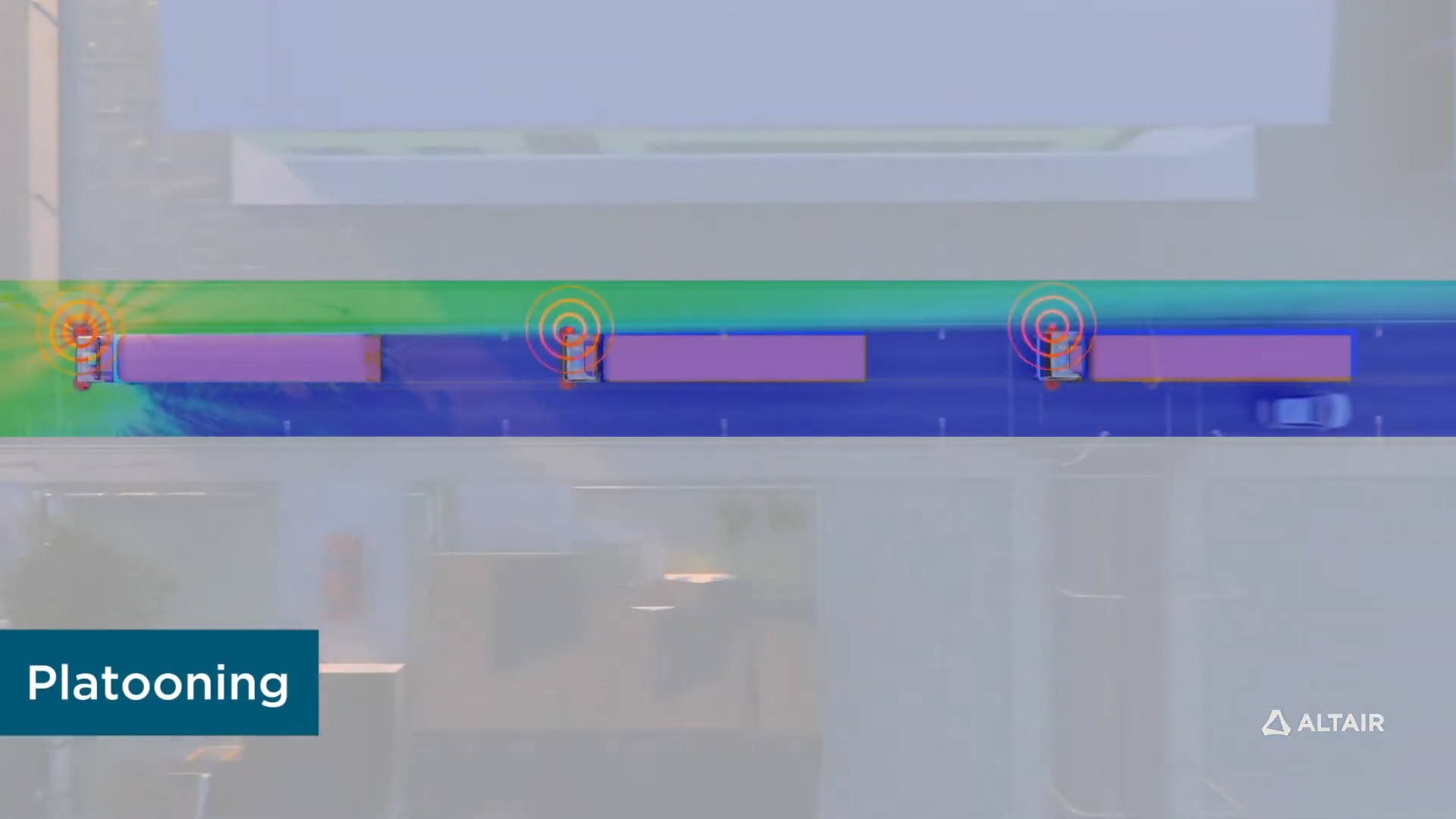
Altair's software allows engineers to design, optimize, and test vehicle connectivity (like 5G, Wi-Fi, and Vehicle-to-Everything communication) entirely within a virtual environment. This "virtual test drive" saves millions in physical prototyping. However, the software's outputs are abstract: data sheets, gain plots, and complex calculations. Altair needed a way to show this invisible process in action, demonstrating how their platform solves real-world challenges like antenna co-existence, signal platooning, and over-the-air updates in a way that was both engaging and technically irrefutable.
The Solution
Advids conceptualized and executed a comprehensive 3D animation that created a photorealistic "digital twin" of a modern city and a concept vehicle. This virtual world served as a stage to dynamically visualize Altair's simulation data. The cornerstone of the project was a custom, data-driven animation script that ingested Altair's raw engineering data to procedurally generate and animate complex 3D visualizations, such as antenna radiation patterns and signal ray-tracing, ensuring perfect technical accuracy.
Client Profile
Altair is a global technology company that provides software and cloud solutions in simulation, high-performance computing, and data analytics. Their tools are used by engineers and scientists across industries to design and optimize complex products and processes, with a major focus on the automotive sector.
Project Objective
To create a flagship 3D technical video demonstrating the full spectrum of Altair's connectivity simulation suite. The video needed to showcase multiple, complex use-cases, from initial antenna design exploration to large-scale urban signal performance, all while maintaining photorealistic visual quality and absolute engineering precision.
The Advids Precision Visualization Workflow
For this project, Advids employed its specialized 3D technical pipeline. The workflow was custom-configured to handle the unique challenge of data-driven animation, focusing on the accurate, procedural visualization of invisible simulation data rather than just artistic representation.
- Data Ingestion & Optimization: Processing and optimizing client-provided 3D assets, including complex Computer-Aided Design models of the vehicle and large-scale urban environments.
- Data-Driven Animation (R\&D): Developing custom scripts to parse raw engineering data files (e.g., .csv, .dat) and use them to drive the parameters of 3D animated meshes.
- Photorealistic Look Development: Utilizing Physically Based Rendering and Image-Based Lighting to achieve a photorealistic "digital twin" aesthetic for the car and city.
- Complex Compositing: Seamlessly integrating 3D animation, data visualizations, and animated 2D User Interface elements into a single, cohesive narrative.
Project at a Glance
| Feature | Detail |
|---|---|
| Client | Altair |
| Agency Partner | Advids |
| Project | 3D Animation for Automotive Connectivity Simulation Platform |
| Video Type | 3D Industrial/Technical Animation |
| Estimated Duration | 10 Weeks |
| Core Technologies | 3D Animation Suite, GPU/CPU Render Farm, Compositing Suite, Custom Python Scripting |
| Collaboration Stack | Slack (Real-time Communication), Google Drive (Asset Management), Vimeo Review (Video Feedback) |
| Final Deliverables | Main 2:30 4K Video, Multiple Short-Form Use-Case Edits |
Project Timeline
- 1. Kickoff & Data Ingestion (Week 1-2)
- Milestone: Strategy session and asset collection.
- Key Outputs: Client brief confirmed. Received Concept_Car_V4.STEP and raw Antenna_Pattern_Data_V3.csv files.
- Quote (Client): "This cannot be just 'art.' Every pattern and signal path you show must be a direct visualization of our simulation data. Our audience is engineers; they will know if it's fake."
- 2. Previsualization & Environment Build (Week 2-3)
- Milestone: Lock down all camera paths and story beats.
- Key Outputs: Previs_Animatic_R3.mp4 created, showing the full video with simple block-models. Environment build of the "digital twin" city begins.
- 3. Look Development & Aesthetic (Week 3-4)
- Milestone: Approval of the final look and feel.
- Key Outputs: StyleFrames_Car_Studio_V5.png approved. The photorealistic look for the car and city is established.
- Quote (Advids): "We're balancing photorealism with a clean, 'simulation' aesthetic. The lighting will be bright and clear, like a perfect test day, to emphasize clarity and precision."
- 4. The Data-Driven Breakthrough (Week 4-6)
- Milestone: Successful development and testing of the data-driven animation script.
- Key Outputs: Data_Vis_Test_R2.mp4 showing the script ingesting client data to create an animated 3D mesh.
- Quote (Advids): "The script is working. We can now load the client's new data sets and generate the corresponding 3D antenna patterns in minutes, not days. This is our breakthrough."
- 5. Production & Compositing (Week 7-9)
- Milestone: All scenes are animated, lit, and rendered.
- Key Outputs: Rendered image sequences for all 3D scenes. User Interface elements (like the in-car display) are designed and composited.
- 6. Final Review & Delivery (Week 10)
- Milestone: Final client approval and delivery.
- Key Outputs: Final 4K video delivered.
The Production Deep Dive: Engineering a "Digital Twin" Test Platform
Phase 1: Data Ingestion: Building the Virtual World
Goal: To create the photorealistic 3D car and large-scale city environment that would serve as the "virtual test platform."
Process: The project began with the client providing the hero 3D model of the car (Concept_Car_V4.STEP), a complex Computer-Aided Design file. The Advids 3D team meticulously optimized this model, using Tessellation to convert the engineering-grade model into millions of polygons that were efficient for high-end animation and rendering.
(IMG ASSET 1)
Workflow Action: Simultaneously, our team built the sprawling urban environment seen in the opening and in the large-scale simulations. This "digital twin" was not just a backdrop; it was a functional 3D asset essential for visualizing real-world scenarios like signal reflections and Vehicle-to-Everything communication.
Phase 2: Look Development: Photorealism for Cars and Code
Goal: To establish a clean, premium, and technically precise visual style.
Process: We used Physically Based Rendering to ensure all materials—from the car's metallic paint and glass to the asphalt and concrete of the city—reacted to light as they would in the real world. This commitment to realism was crucial for building credibility with an engineering audience.
Feedback Loop: Refining the 'Digital Twin' Aesthetic
- Client: "We've reviewed the Previs_Animatic_R3.mp4 on Vimeo Review. The camera work is great, but the city streets feel empty and generic. It doesn't feel like a living test environment."
- Advids: "This is excellent feedback. We'll add more environmental details—traffic lights, street furniture, and simulated traffic. This will increase the scene's realism and better sell the 'virtual test drive' concept."
Phase 3: The Critical Juncture: Animating Invisible Engineering Data
Goal: To accurately and dynamically animate the invisible electromagnetic simulation data from Altair's software.
Process: This was the single greatest challenge and opportunity of the project. The client needed to show how different antenna designs (00:25) produced different performance patterns (00:38). They provided raw data in .csv files, not 3D models.
(IMG ASSET 2)
The Data Challenge: Manually modeling these complex, organic 3D patterns from thousands of data points was not feasible. It would be slow, expensive, and risk introducing inaccuracies.
The Breakthrough: The Advids technical team developed a custom script that acted as a bridge between Altair's engineering data and our 3D animation software. This script would:
- Read the Antenna_Pattern_Data_V3.csv file directly.
- Parse the thousands of gain and direction data points.
- Procedurally generate a 3D "spline cage" mesh representing that exact pattern.
- Apply shading and animation controls to this new 3D model.
This data-driven pipeline was a game-changer. It meant Advids could ensure 100% fidelity to the source data. This workflow was also used to generate the complex ray-tracing paths for the city-wide simulation (01:28).
(IMG ASSET 3)
Feedback Loop: Achieving Dynamic Data Morphing
- Client: "The Data_Vis_Test_R2.mp4 is technically accurate, which is fantastic. But the transition between the different antenna patterns is just a simple cross-fade. It feels static. Can we make it look more like an optimization process?"
- Advids: "Yes. We can upgrade the script. Instead of just generating one pattern, we'll have it load two data sets and mathematically interpolate between them. This will create a fluid 'morphing' animation, as if the pattern is dynamically changing as the design is optimized."
This solution, born from a client's technical feedback, became a central visual element of the video (seen at 00:25-00:31) and perfectly illustrated the concept of "antenna optimization."
Synergy Analysis: Technology vs. Human Expertise
This project's success was built on the synergy between powerful software and expert human curation.
- Technology-Powered Contributions
- Procedural Generation: The custom script automated the creation of complex 3D models from raw data, eliminating human error and saving weeks of manual labor.
- Photorealistic Rendering: Physically Based Rendering engines created the tangible, believable world necessary to ground the abstract concepts.
- Large-Scale Environments: 3D software's ability to handle massive scenes allowed us to visualize a full "digital twin" of a city for the ray-tracing simulation.
- Advids’ Visualization Craft (Human Expertise)
- Technical Problem-Solving: Identifying the need for, and then developing, the custom data-driven script. This is a core part of the Advids value, moving beyond "animating" to "engineering" a visual solution.
- Narrative Design: Weaving disparate technical features (antenna design, platooning, updates, User Interface) into a single, logical, and compelling story.
- Aesthetic Curation: Defining the "clean simulation" aesthetic—balancing realism with the clarity needed to explain complex technical ideas.
- Responsive R\&D: Acting on expert client feedback (like the "morphing" request) and developing a new technical solution (data interpolation) to meet the need.
Outcomes & Strategic Learnings
1. A New Benchmark for Technical Visualization
The final video set a new standard for Altair in communicating its most complex products. By creating a "virtual test drive," we successfully translated abstract software capabilities into a tangible, high-impact narrative that resonated deeply with their engineer-focused audience.
2. The Power of Data-Driven Animation
The Advids Precision Visualization Workflow, specifically the custom script, proved that direct integration of engineering data is possible. This opens the door for future projects where simulation data can be visualized with guaranteed accuracy and unprecedented speed.
3. Creation of a Scalable "Digital Twin" Asset
The 3D car and city environment are high-value, reusable assets. They can be leveraged by Advids for future Altair animations, creating a consistent visual brand for their entire virtual testing suite and significantly reducing costs on future productions.
4. Technical Credibility Builds Trust
The most important outcome was the enthusiastic reception from Altair's internal engineering teams. By committing to 100% data-fidelity, the video earned the credibility it needed to be an effective sales and marketing tool, proving that Advids speaks the language of engineering.
Final Video
Author & Editor Bio