
Connecting the Links: How Advids Crafted a Narrative Explainer for 'Planning in a box'
Summary
This case study examines the 6-week production of a 2D motion graphics explainer video for the "Planning in a box" software. The client needed to explain their complex, multi-faceted supply chain solution—which leverages Internet of Things data—in a way that was simple, engaging, and persuasive. The core challenge was translating an abstract software concept into a tangible, human-centric story. By employing The Advids Clarity & Engagement Framework, our team pivoted from a feature-based pitch to a problem-centric narrative, resulting in a clear and compelling video that built an emotional connection with the target audience.
The Challenge
"Planning in a box" offers a powerful Software-as-a-Service platform designed to connect every link in a manufacturing supply chain, from initial planning to the factory floor and final delivery. The problem was that the software's greatest strength—its comprehensive, all-in-one nature—also made it difficult to explain. A simple feature list would be overwhelming and fail to capture the high-stakes value of the solution. The client needed a video that could instantly communicate the pain of a disconnected supply chain and the relief their software provides.
The Solution
Advids developed a narrative-driven explainer video that framed the software as the "hero" of the story. Instead of leading with the software, the video opens with the problem: a planner, a factory, and a delivery truck, all working in silos. This quickly escalates to a "SHORTAGE" alert on the production line, creating a moment of tension that is all too familiar to the target audience. Only then is "Planning in a box" introduced as the central, connecting solution, bringing visibility and collaboration to the stressed-out team. This "Problem-Agitate-Solution" structure, executed in a clean and modern 2D vector style, made the software's value proposition immediately clear.
Client Profile
"Planning in a box" is an innovative technology company providing a "Connected Supply Chain" platform. Their solution helps businesses move beyond spreadsheets and siloed data by providing real-time visibility and planning tools, likely leveraging Internet of Things (IoT) sensors and cloud computing.
Project Objective
To create a high-impact explainer video that could be used in sales meetings, on the company website, and in marketing campaigns. The primary goal was to generate qualified leads by clearly articulating the problem of a disconnected supply chain and demonstrating how "Planning in a box" solves it.
The Advids Clarity & Engagement Framework
For this project, Advids utilized its proven 2D motion graphics workflow, which is designed to distill complex ideas into clear and engaging visual stories.
- Visual Strategy: Defining the core message and narrative structure ("Problem-Agitate-Solution").
- Storyboarding: Visualizing the entire narrative, scene by scene, to map out the visual and emotional journey.
- Vector Illustration: Creating a unique and brand-aligned visual world, including characters, environments, and User Interface elements.
- Keyframe Animation: Bringing the story to life with fluid motion, seamless transitions, and character animation.
- Final Mastering: Integrating sound design and music to create a polished, broadcast-ready final asset.
Project at a Glance
| Feature | Detail |
|---|---|
| Client | Planning in a box |
| Agency Partner | Advids |
| Project | 2D Motion Graphics Explainer Video |
| Video Type | 2D Motion Graphics/Explainer |
| Estimated Duration | 6 Weeks |
| Core Technologies | Vector Illustration Software, 2D Animation Suite (After Effects), Audio Editing Software |
| Collaboration Stack | Slack (Real-time Communication), Google Drive (Asset Management), Vimeo Review (Video Feedback) |
| Final Deliverables | 1:15 Explainer Video (4K Resolution), 3x 15-second social media cutdowns |
Project Timeline
- Week 1: Kickoff and Scripting
- Milestone: Strategic alignment and script approval.
- Key Outputs: Script_V2_Approved.docx.
- Quote: "We need viewers to feel the stress of a line-down situation. It has to be relatable."
- Week 2: Storyboarding and the "Conceptual Pivot"
- Milestone: Narrative structure approved.
- Key Outputs: Storyboard_V1_Technical.pdf (Pivoted from), Storyboard_V2_Narrative_Pivot.pdf (Approved).
- Quote: "This new narrative storyboard is perfect. It tells the story of the problem we solve, not just the features we have."
- Week 3: Visual Design and Asset Creation
- Milestone: Visual style and character design approved.
- Key Outputs: Style_Frames_Palette_C_V3.png (showing all key scenes and character styles).
- Week 4: Animation and Animatics
- Milestone: Full-length animatic (a timed storyboard) approved.
- Key Outputs: Animatic_V2.mp4.
- Quote: "The pacing feels right. The transition from the office to the factory is seamless."
- Week 5: Full Animation and Review
- Milestone: First full-animation draft submitted for review.
- Key Outputs: Full_Animation_V1_Review.mp4 posted on Vimeo Review.
- Week 6: Final Revisions and Mastering
- Milestone: Final video delivery.
- Key Outputs: Final 4K video file and all associated cutdowns.
The Production Deep Dive: From Abstract Concept to Clear Narrative
Phase 1: The "Conceptual Pivot": Finding the Story
Goal: To define a narrative that could explain a complex software solution in a simple, human, and engaging way.
Process: The project's most critical moment happened during the visual strategy phase. The initial brief focused on the software's features—planning modules, data analytics, and communication channels. Our initial storyboard (Storyboard_V1_Technical.pdf) reflected this, but it felt like a technical manual. It was accurate but lacked a "hook."
The Critical Juncture: Advids' creative team proposed a "Conceptual Pivot." We argued that to sell the solution, we first had to sell the problem. This meant restructuring the entire narrative. We developed Storyboard_V2_Narrative_Pivot.pdf, which delayed the introduction of the software. Instead, it spent the first 10 seconds building the world of the disconnected supply chain and culminating in the "SHORTAGE" alert.
(IMG ASSET 1)
(Timestamp: 10s) The "SHORTAGE" alert. This is the core emotional hook, establishing the high-stakes problem before any solution is mentioned.
Action: This problem-centric approach immediately resonated with the client. It created a "villain" for the story, which allowed the "Planning in a box" software to be introduced as the clear "hero" that resolves the conflict.
Feedback Loop: The "Conceptual Pivot"
- Client: "We've reviewed the first storyboard. It shows all the features we discussed, but... it feels a bit flat. It doesn't have the 'punch' we were hoping for."
- Advids: "We agree. We've been thinking about this and would like to propose an alternative narrative. Instead of leading with the what, we lead with the why. Let's show the 'line down' scenario first. We build the tension, show the problem, and then we introduce our solution. It makes the software the answer to a question the viewer is already asking."
- Client: "We love that. Let's see that version. Getting to the problem faster is exactly what our customers care about."
Phase 2: Building the World: Vector Illustration and Brand Identity
Goal: To develop a clean, modern, and professional visual style that aligned with the "Planning in a box" brand.
Process: With the narrative approved, the Advids illustration team began building the visual assets. The style needed to be simple enough to be understood at a glance, yet detailed enough to be relatable. We used the client's core brand colors, using their bright orange as a key "action" color (for alerts, buttons, and highlights) to guide the viewer's eye.
(IMG ASSET 2)
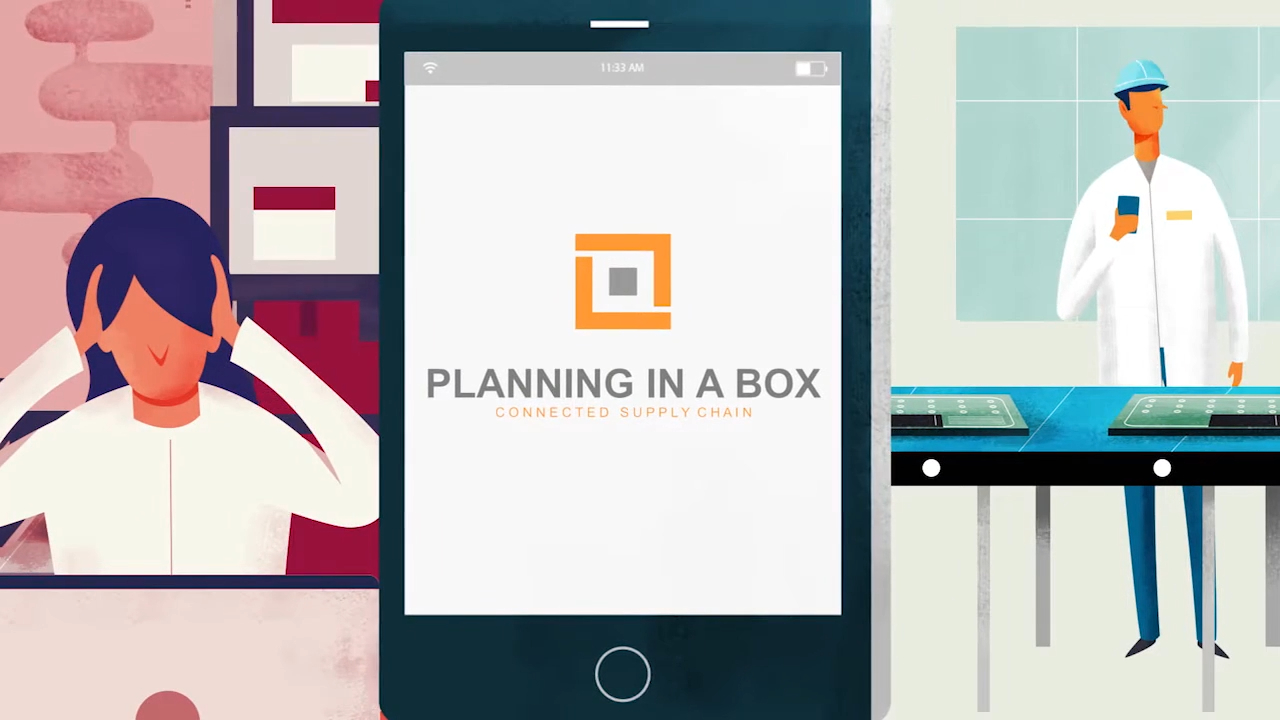
(Timestamp: 14s) The "Planning in a box" app is introduced at the moment of peak chaos, visually positioning it as the central solution.
Action: We created a complete library of vector assets, including characters (planner, factory worker, manager), environments (office, factory, delivery location), and stylized User Interface elements. This consistency ensured the video felt like a cohesive part of the client's brand ecosystem.
Phase 3: The Motion Framework: Animating the Connected Supply Chain
Goal: To bring the vector assets to life with smooth, fluid motion that reinforces the theme of "connection."
Process: The animation style was key. We avoided jarring cuts. Instead, the Advids animation team used seamless transitions, like panning from the planner's computer (00:04) directly to the factory floor (00:06), visually linking these two siloed environments. The Keyframe Animation was carefully timed with "easing" to feel modern and polished, not robotic.
(IMG ASSET 3)
(Timestamp: 32s) This shot shows the "connected" nature of the solution, animating the User Interface to show real-time collaboration between team members.
Action: A major focus was animating the software's User Interface. We had to show complex actions (video chat, messaging, analytics) in a way that was clean and easy to follow.
Feedback Loop: Animating the User Interface
- Advids: "Here is the first animation draft (Full_Animation_V1_Review.mp4). We've focused on the User Interface elements, particularly the video chat and the dashboard, to show how the team gets connected."
- Client: "This looks great. On the dashboard graph at 0:57, can we make the 'Demand' line (red) look more dramatic, and then show the 'Supply' line (blue) rising to meet it? We want to visually reinforce the 'problem-solved' moment."
- Advids: "Excellent note. We will adjust the Keyframe Animation on that graph to create a more obvious 'gap' that then 'closes.' This will provide a stronger visual payoff. We'll have a new version for you tomorrow."
Synergy Analysis: Technology vs. Human Expertise
This project was a classic example of how creative strategy and human expertise are more important than raw technical complexity.
- Technology-Powered Contributions:
- 2D Animation Suite: Software like After Effects was the engine that allowed us to build and animate the entire world, creating fluid motion and complex layer-based scenes.
- Vector Illustration Software: Enabled the creation of crisp, infinitely scalable assets that are lightweight and perfect for web and mobile viewing.
- Vimeo Review: Our review platform was crucial for gathering precise, time-stamped feedback, especially for timing and animation nuances.
- Advids’ Visualization Craft (Human Expertise):
- Strategic Storytelling: The "Conceptual Pivot" was a purely human-led, strategic decision. This
craft—knowing how to tell a story to a specific audience—was the single most important factor in the video's success.
- Visual Simplification: Advids' expertise lies in taking a complex idea like "connected supply chain" and boiling it down to simple, understandable visual metaphors (like the "SHORTAGE" sign or the connecting lines).
- Brand-Aligned Motion: Our animators didn't just "make things move." They created a motion language (smooth pans, clean User Interface reveals) that felt professional, modern, and aligned with the client's identity as a cutting-edge tech company.
- Strategic Storytelling: The "Conceptual Pivot" was a purely human-led, strategic decision. This
Outcomes & Strategic Learnings
A Clear, Compelling Sales Tool
The final video was a resounding success. It transformed an abstract, complex software platform into a simple, easy-to-understand story. The client's sales team reported that the video was "night and day" compared to their old pitch decks, as it allowed them to establish the problem and solution in the first 60 seconds of a meeting.
(Timestamp: 57s) This clear data visualization of 'Supply' vs. 'Demand' provided a tangible, easy-to-understand Key Performance Indicator, demonstrating the software's value.
The Power of a Problem-Centric Narrative
This project was a powerful reminder that for explainer videos, the "problem" is the hook. By focusing on the audience's pain point first, the solution becomes more resonant and necessary. For complex Software-as-a-Service or Internet of Things products, this narrative pivot is non-negotiable.
Scalable Visual Assets
The complete library of vector illustrations (characters, icons, environments) created by Advids became a valuable, scalable asset for the client. They were able to repurpose these assets on their website, in print collateral, and in social media posts, creating a strong, consistent visual brand identity far beyond the video itself.
Final Video
Author & Editor Bio