Executive Summary
For manufacturers of heavy-duty industrial equipment, the most significant selling points often lie hidden beneath layers of cast iron and steel. Caprari, a leader in pumping solutions, approached Advids to create a high-end Computer-Generated Imagery (CGI) commercial for their new "K+ Energy" range. The challenge was to visualize the internal "DryWet" cooling system and the "Non-Stop" anti-clogging impeller—technologies that are impossible to film with traditional cameras. Utilizing the Advids Precision Visualization Workflow, we transformed complex engineering data into a cinematic, photorealistic visual narrative that highlights efficiency and reliability.
The Challenge: Visualizing the Invisible
The "K+ Energy" pump features a proprietary "DryWet System"—a cooling mechanism that uses oil to actively cool the motor, allowing the pump to operate even when not submerged. This is a complex thermodynamic process hidden inside a sealed metal unit.
- The Visibility Constraint: Traditional videography could not penetrate the housing to show the oil circulation or the internal mechanics of the IE3 motor.
- The Aesthetic Hurdle: The product is industrial black metal. Showcasing it against a premium dark background without losing visual definition required a sophisticated lighting strategy.
- The Technical Requirement: The client needed to prove the "Non-Stop" system’s ability to handle fibrous waste without clogging, requiring accurate physics-based particle simulation.
The Solution: Advids Precision Visualization
Advids deployed a full-spectrum 3D production pipeline, moving from raw engineering schematics to a broadcast-ready commercial. By utilizing Physically Based Rendering and advanced Fluid Dynamics simulations, we created a "digital twin" of the pump. This allowed us to virtually "slice" the product open, revealing the oil cooling loop and the impeller mechanics in a way that is both technically accurate and visually arresting.
Project at a Glance
| Category | Details |
|---|---|
| Project Name | K+ Energy: The DryWet System Launch |
| Client Industry | Industrial Manufacturing & Water Management |
| Video Type | 3D Industrial/Technical Animation |
| Production Timeline | 8 Weeks |
| Primary Deliverables | 60-Second Commercial, 3x Technical Cut-downs |
| Collaboration Stack | Slack (Real-time Communication), Google Drive (Asset Management), Vimeo Review (Video Feedback) |
Project Timeline: From Blueprints to Broadcast
- Week 1: Data Ingestion & Optimization
- Received raw
Caprari_KPlus_Assembly_Raw_v04.stepfiles from the client’s engineering team. - Advids technical artists performed tessellation and topology cleanup to prepare the Computer-Aided Design data for animation.
- Received raw
- Week 2: Visual Strategy & Look Development
- Creation of "Dark Mode" style frames.
- Artifact:
Style_Frame_Lighting_Concept_v03.png.
- Week 3-4: Animation & Rigging
- Rigging the exploded view sequences to showcase the IE3 motor and shaft components.
- Quote (Advids Internal): "The explosion needs to be rhythmic. Let's sync the component expansion to the bass of the soundtrack."
- Week 5-6: Simulation & Texturing (The Critical Juncture)
- Development of the oil cooling fluid simulation and wastewater particle flow.
- Artifact:
Oil_Viscosity_Test_v09.abc(Alembic Cache).
- Week 7: Rendering & Compositing
- Final render passes using Image-Based Lighting.
- Compositing motion-tracked text overlays.
- Week 8: Final Mastering
- Color grading and sound design integration.
The Production Deep Dive
Stage 1: Translating Engineering Data
The foundation of the project was accuracy. We began by importing the client's manufacturing files. Often, these files are too dense for visual animation software. The Advids team utilized retopology techniques to reduce the polygon count while maintaining the perfect curvature of the impeller and housing. This ensured that the subsequent simulations would interact with accurate collision geometry.
Stage 2: Illuminating the Depths (Look Development)
Goal: To make a black product look premium against a black background.
Process: We utilized a "chiaroscuro" lighting technique. By using strong rim lights and cool, cyan-tinted fill lights, we separated the pump from the background.
Action: We applied Physically Based Rendering materials. The cast iron housing was given a rough, light-absorbing texture, while the stainless steel bolts and shaft were given high reflectivity to catch the highlights.
Visual Proof:
(IMG ASSET 1 - 00:02) The Hero Reveal. This shot demonstrates the rim-lighting strategy, outlining the "Caprari" logo and the pump's silhouette against the dark void.
Stage 3: The Simulation Breakthrough (Fluid Dynamics)
Challenge: The core feature, the "DryWet System," uses oil for cooling. Visualizing clear oil inside a metallic chamber is notoriously difficult—it can look like empty space or, if done poorly, like thin water.
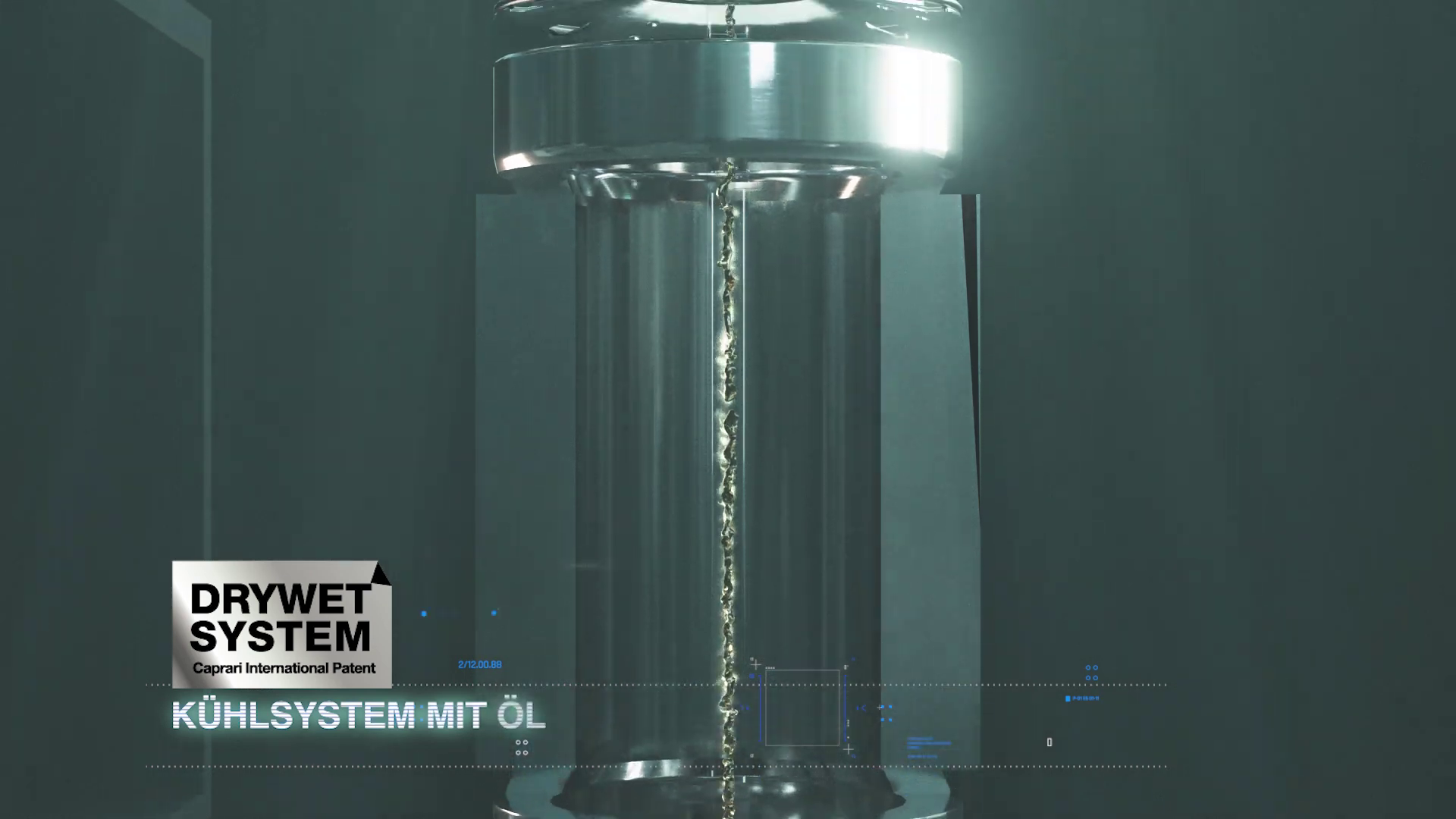
Process: The Advids simulation team developed a custom viscous fluid solver. We adjusted the refractive index of the fluid material to match industrial oil and introduced micro-bubbles into the simulation. These bubbles caught the light, defining the volume and flow direction of the oil without obscuring the motor components behind it.
Feedback Loop: The Viscosity Balance
Client: "We reviewed
Sim_Test_v04on Vimeo Review. The fluid creates too much turbulence. It looks like water. The cooling oil is thicker; it needs to move with more weight to show it protects the motor."Advids: "Understood. We have adjusted the viscosity settings in the solver and reduced the velocity. We also added a golden tint to the shader to visually differentiate it from the external water. Please see
Oil_Cooling_Sim_Cache_v12."
Visual Proof:
(IMG ASSET 2 - 00:21) The Oil Cooling Simulation. This cutaway shot reveals the golden, viscous oil circulating around the motor shaft, demonstrating the "DryWet" technology in action.
Stage 4: Validating the "Non-Stop" System
To prove the anti-clogging capabilities, we needed to simulate debris. We utilized a particle system to generate fibrous green matter. The simulation required precise collision detection to show the matter entering the intake, being processed by the impeller, and being ejected without getting stuck. This visual validation was crucial for the product's market claims.
Visual Proof:
(IMG ASSET 4 - 00:47) The Debris Test. Green particles simulating fibrous waste are shown flowing smoothly through the impeller, visually validating the anti-clogging engineering.
Synergy Analysis: Technology & Expertise
- Technological Precision: The use of high-end simulation software allowed us to model fluid behaviors (viscosity, turbulence, surface tension) that are scientifically accurate, lending credibility to the engineering claims.
- Human Artistry: While the physics were computer-generated, the look was handcrafted. The Advids lighting artists ensured that every reflection and highlight guided the viewer's eye to the specific component being discussed, turning a technical diagram into a piece of cinematic art.
Outcomes & Strategic Learnings
The final video successfully launched the K+ Energy range, providing sales teams with a tool to explain the invisible advantages of the system.
- Clarity of Complex Systems: The exploded views and transparency shaders successfully educated the audience on the internal "DryWet" patent.
- Visual Proof of Reliability: The particle simulations provided visual evidence of the anti-clogging features, building trust with potential buyers.
- Asset Versatility: The high-fidelity 3D assets created by Advids were subsequently used for high-resolution print brochures and trade show banners, maximizing the client's return on investment.
Would you like me to develop a social media teaser strategy derived from these 3D assets to extend the campaign's reach?
Final Video
Author & Editor Bio