
Summary
In the high-stakes market of home energy security, demonstrating reliability is paramount. This case study details how Advids partnered with a leading energy technology brand to produce a compelling Direct-to-Consumer marketing video. By seamlessly integrating Three-Dimensional product visualizations into client-sourced live-action footage, Advids created a narrative that juxtaposes the chaos of power outages with the serenity of automated backup power. The project demanded high-fidelity Computer-Generated Imagery, precise motion tracking, and atmospheric compositing to ground the digital product within a realistic, storm-swept environment.
The Challenge: Selling Peace of Mind in a Storm
The client faced a logistical and creative hurdle: demonstrating their Home Standby Generator in the worst possible weather conditions without risking crew safety or relying on unpredictable nature. They possessed high-quality live-action footage of actors struggling with portable generators in simulated rain and snow. However, they lacked the "hero" shots of their product functioning autonomously in those same conditions. The challenge was to insert the generator into these scenes digitally, ensuring it looked not like a pristine model floating on a screen, but like a physical object weathering the storm. The white casing of the unit needed to reflect the chaotic environment while remaining the clean, visual anchor of the story.
The Solution: The Advids Precision Visualization Workflow
Advids implemented a hybrid post-production pipeline, treating the video as a Visual Effects shot. We utilized the Advids Precision Visualization Workflow, focusing on photorealistic rendering and compositing.
- Virtual Product Integration: We utilized the client's engineering files to create a hyper-realistic Three-Dimensional digital twin of the generator.
- Atmospheric Matching: We developed custom shaders to simulate wet surfaces, snow accumulation, and rain interaction on the generator's casing.
- Motion Graphics Overlays: To visualize the invisible flow of electricity, we tracked dynamic "energy lines" into the footage, clearly communicating the product's function without breaking the cinematic immersion.
Client Profile and Objective
- Client: A global leader in the design and manufacture of power generation equipment.
- Industry: Energy Technology / Home Improvement.
- Core Objective: To visually articulate the value proposition of automatic home standby power versus portable solutions, targeting homeowners concerned about increasing grid instability.
The Advids Precision Visualization Workflow
This project utilized a specialized module designed for high-end product integration.
1. Data Ingestion & Optimization
Converting complex manufacturing data into render-ready geometry.
2. Camera Tracking & Match-moving
Analyzing live-action plates to recreate the camera's motion in Three-Dimensional space.
3. Look Development & Texturing
Creating physically accurate materials that respond to light and weather.
4. Scene Integration & Lighting
Using High Dynamic Range Imaging to match the digital lighting to the live-action plate.
5. Compositing & Grading
The final blending of layers, ensuring color consistency and visual cohesion.
Project at a Glance
| Category | Details |
|---|---|
| Project Type | Direct-to-Consumer Marketing Video |
| Primary Workflow | The Advids Precision Visualization Workflow |
| Visual Style | Cinematic Live Action with Photorealistic Computer-Generated Imagery |
| Collaboration Stack | Slack (Real-time), Google Drive (Assets), Vimeo Review (Feedback) |
| Est. Production Time | 7 Weeks |
| Deliverables | 30-Second Commercial Spot, Social Media Cut-downs |
Project Timeline
-
Week 1: Asset Ingestion and Strategy
- Received 4K Log live-action plates and product Computer-Aided Design files.
- Defined the "Weathering Strategy" for the generator's surface look.
- Output:
Asset_Manifest_v01.pdf
-
Week 2: Geometry Optimization and UV Mapping
- Retopologized the industrial model for efficient rendering.
- Unwrapped UVs to allow for custom texture painting (dirt, water droplets).
- Output:
Generac_Guardian_Optimized_Mesh_v02.obj
-
Week 3: Match-moving and Layout
- Tracked the camera movement for the backyard and aerial shots.
- Placed the digital generator into the Three-Dimensional scene to match the perspective of the house.
- Output:
Camera_Track_Solves_v01.mb
-
Week 4: Look Development and Lighting (The Critical Juncture)
- Iterative lighting tests to match the "stormy night" ambiance.
- Simulated rain interaction on the generator lid.
- Output:
Style_Frame_Storm_Night_v03.png
-
Week 5: Motion Graphics and Animation
- Animated the generator lid opening and the green "Power Flow" indicators.
- Quote (Client): "The green line needs to feel like energy, not just a flat vector. Can we add a subtle glow?"
-
Week 6: Compositing and Final Polish
- Composited the render passes (Reflection, Specular, Shadow) over the live-action plates.
- Applied final color grading to unify the black levels.
- Output:
Composite_Master_v01.mov
-
Week 7: Final Delivery
- Delivered final broadcast-ready files in required codecs.
- Output:
N10A374_Master_ProRes422.mov
The Production Deep Dive
Stage 1: The Integration of Reality and Render
The project began with a distinct divide: raw footage of actors in a simulated storm and pristine digital files of the generator. The goal was to bridge this gap. Advids initiated the process by analyzing the "noise profile" and "film grain" of the client-sourced footage. We mapped the lens distortion of the physical cameras used on set to our virtual cameras, ensuring that the digital generator would exhibit the same optical characteristics as the rest of the scene.
Stage 2: Critical Juncture – The "Wet Look" Challenge
The Challenge: Placing a clean, white metal object into a dark, rainy scene presents a physics challenge. If the object is too bright, it looks pasted on. If it's too dark, the product is lost. Furthermore, the object needed to appear wet, with water beading and streaking, to match the rain-soaked environment.
The Constraint: We could not physically wet the digital model; we had to simulate the behavior of light hitting water on a coated metal surface.
The Solution: Advids employed a Physically Based Rendering workflow. We created a multi-layered material shader. The base layer represented the white powder-coated metal. Above that, we added a dynamic "roughness" map that simulated water droplets and streaks, affecting how the simulated lightning flashes reflected off the surface. We used a "Projection Mapping" technique to project the live-action plate onto the digital environment, ensuring the generator reflected the actual trees and house from the footage, rather than a generic map.
Stage 3: Feedback Loop – Defining the Visual Language
Effective collaboration via Vimeo Review was crucial for fine-tuning the visual effects.
- Feedback Loop: Refining the Power Flow
- Client: "In the shot at 0:27, the green line indicating power restoration is too opaque. It covers the texture of the house wall too much. It needs to look integrated, like a projection or a hologram, rather than a sticker."
- Advids: "Understood. We are switching the blending mode to 'Add' and reducing the fill opacity. We will also add a slight distortion effect to the line so it contours over the brickwork of the house, emphasizing that the power is flowing into the home structure."
- Artifact:
Comp_Test_PowerFlow_v04.mp4
Stage 4: Visualizing the Invisible
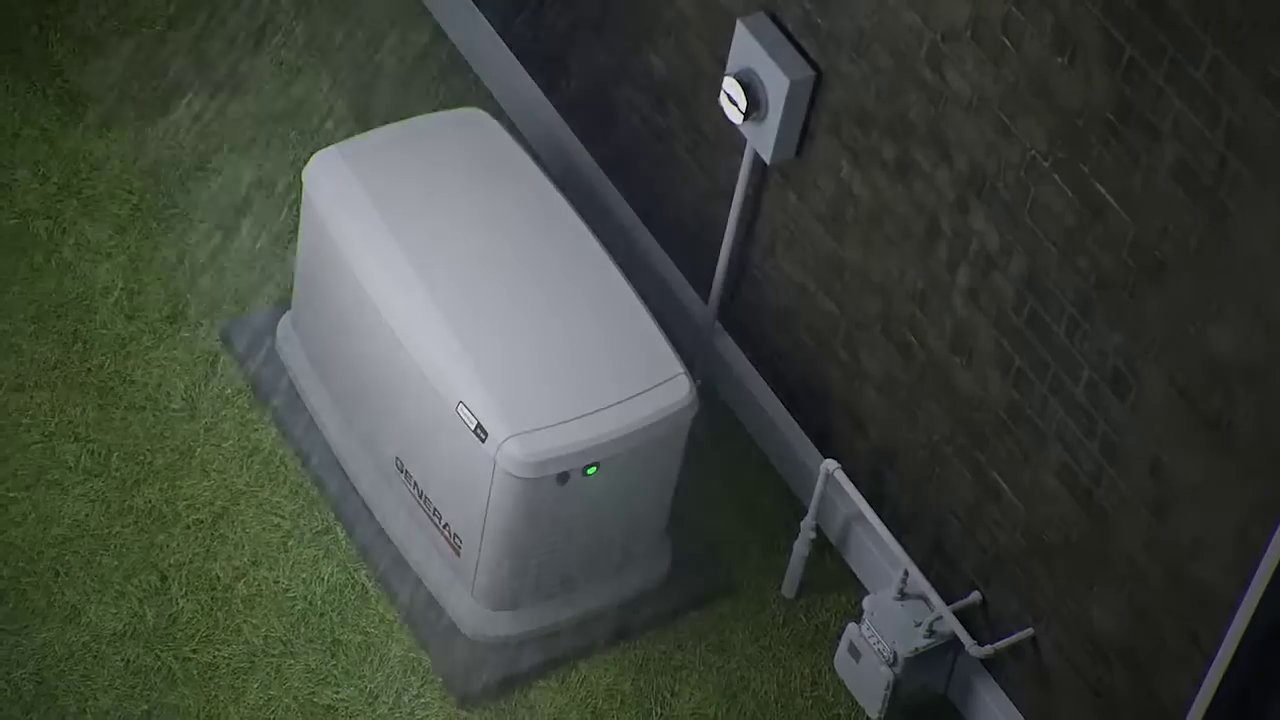
Beyond the physical product, we needed to visualize the concept of "automatic restoration." At timestamp 0:30, the generator's status light turns green. This subtle animation required precise timing. Advids animated the emission channel of the Light Emitting Diode to pulse slightly before stabilizing, mimicking the real-world boot-up sequence of the electronics, adding a layer of subconscious realism for tech-savvy viewers.
Visual Asset Analysis
| Serial No. | Timestamp | Visual Rationale | Strategic Placement |
|---|---|---|---|
| 1 | 00:02 | The Product Reveal: Demonstrates the high-fidelity modeling and clean lighting setup used to introduce the product before placing it in the chaotic environment. | Introduction / Summary |
| 2 | 00:21 | The Integration: The core visual achievement. The 3D generator is perfectly tracked and lit to sit naturally in the rain-soaked, live-action backyard plate. | Critical Juncture |
| 3 | 00:27 | Motion Graphics: Shows the "Power Flow" visualization. The green line is tracked to the wall, visually explaining the connection between the unit and the home. | Production Deep Dive |
| 4 | 00:30 | Technical Detail: A close-up on the indicator light. Highlights the attention to detail in material emission and mechanical animation. | Feedback Loop |
Synergy Analysis: Technology meets Human Expertise
This project exemplifies the synergy between Algorithmic Simulation and Artistic Intuition.
- Technology: Provided the heavy lifting—calculating the camera tracks from handheld footage and simulating the complex physics of light reflecting off wet surfaces using Global Illumination algorithms.
- Human Expertise: Advids artists provided the "eye." The algorithms could simulate a wet surface, but the artists decided where the water should streak to look aesthetically pleasing and how the "Power Flow" line should ease in to create a feeling of relief rather than just movement. The decision to balance the exposure of the white generator against the dark background was a purely artistic choice to ensure brand visibility without breaking realism.
Outcomes and Strategic Learnings
The final video successfully translated a complex electromechanical process into an emotional story of security.
- Visual Cohesion: The hybrid approach allowed the client to show their product in "worst-case scenarios" (heavy storm) with "best-case aesthetics" (perfect lighting and product angle), a feat impossible with traditional filming alone.
- Brand Clarity: The use of distinct Motion Graphics (the green line) established a visual shorthand for "power restoration" that can be reused across future campaigns.
- Production Efficiency: By utilizing Computer-Generated Imagery for the product shots, the client saved significant budget on set design and avoided the risks of filming heavy machinery in simulated rain conditions.
Would you like me to analyze the specific tracking techniques used for the 'Power Flow' sequence in greater detail?
Final Video
Author & Editor Bio