Case Study Summary
In the rapidly evolving sector of wearable technology, demonstrating the capabilities of "Smart Glasses" requires a delicate balance between rigorous engineering visualization and relatable consumer utility. Xiaomi approached Advids to create a Mixed Reality explainer video for their new Smart Glasses concept. The goal was to demystify the miniaturized technology housed within a standard-looking eyeglass frame and demonstrate its real-world application through an immersive First-Person Perspective. By deploying the Advids Precision Visualization Workflow, we successfully translated complex optical engineering into a seamless visual narrative, bridging the gap between raw hardware specifications and a magical user experience.
The Visualization Challenge
The core challenge lay in the "invisible" nature of the innovation. The device features a 0.13-inch MicroLED display and optical waveguide technology hidden entirely within the frame. The client needed to show:
- Extreme Miniaturization: How a display smaller than a grain of rice fits into the frame.
- Optical Physics: How light travels through the lens without obstructing vision.
- Mixed Reality Context: How the interface overlays onto the real world without looking like a generic sci-fi movie effect.
The project required handling high-fidelity Computer-Aided Design data while simultaneously executing high-precision motion tracking on client-sourced live-action footage.
Bridging Hardware and Human Experience
Advids engineered a hybrid visual strategy. We utilized photorealistic 3D animation to handle the "Hardware" narrative—stripping back the layers of the device to reveal the internal components. For the "Experience" narrative, we utilized advanced motion tracking and compositing to overlay the User Interface onto real-world scenarios. This approach allowed us to validate the engineering claims with precision while grounding the technology in everyday life.
Client Profile & Objective
- Client: Xiaomi (Consumer Electronics).
- Industry: Wearable Technology / Smart Devices.
- Objective: To launch the Xiaomi Smart Glasses concept, explaining the breakthrough MicroLED and Waveguide technology, and showcasing core features (Navigation, Translation, Notifications) to a global tech-savvy audience.
The Advids Precision Visualization Workflow
To achieve the requisite level of photorealism and technical accuracy, Advids employed a high-end 3D pipeline specialized for industrial design.
Project at a Glance
| Category | Details |
|---|---|
| Project Type | Mixed Reality Explainer Video |
| Workflow Module | Advids Precision Visualization Workflow |
| Core Technologies | 3D Animation, Physically Based Rendering, Motion Tracking |
| Target Audience | Tech Enthusiasts, Early Adopters, Industry Analysts |
| Project Duration | 9 Weeks |
| Deliverables | 1080p Main Film, Social Cutdowns, 3D Render Stills |
| Collaboration Stack | Slack (Daily Stand-ups), Google Drive (Asset Management), Vimeo Review (Frame-accurate Feedback) |
Production Timeline & Key Milestones
- Week 1: Ingestion of Engineering Data (
Xiaomi_Frame_Assembly_v09.step) and Geometric Optimization. - Week 2: Previsualization (Pre-vis) of camera moves and "Exploded View" sequences.
- Week 3: Look Development – Defining the materials for the ceramic frame and optical glass.
- Week 4: Critical Juncture: R&D on Waveguide Light Path Simulation.
- Week 5: Motion Design for Heads-Up Display (HUD) interface elements.
- Week 6: Matchmoving and Compositing of UI elements onto client-sourced footage.
- Week 7: First Cut Delivery and Feedback Cycle 1.
- Week 8: Refinement of Lighting and Texturing (
Render_Pass_Refraction_v04.exr). - Week 9: Final Color Grading and Sound Design Integration.
Deep Dive: Engineering the Future of Sight
1. Data Ingestion and Material Fidelity
Goal: To transform dense manufacturing data into render-ready geometry.
Process: The client provided high-density Computer-Aided Design files. The Advids team utilized tessellation algorithms to optimize the mesh density, ensuring smooth curvature on the frames without crashing the render engine. We then applied Physically Based Rendering (PBR) textures to replicate the specific "black ceramic" finish, focusing heavily on subsurface scattering to give the material depth.
Action: We created specific roughness maps to ensure the studio lighting reflected realistically off the curves of the glasses, avoiding a "plastic" look.
!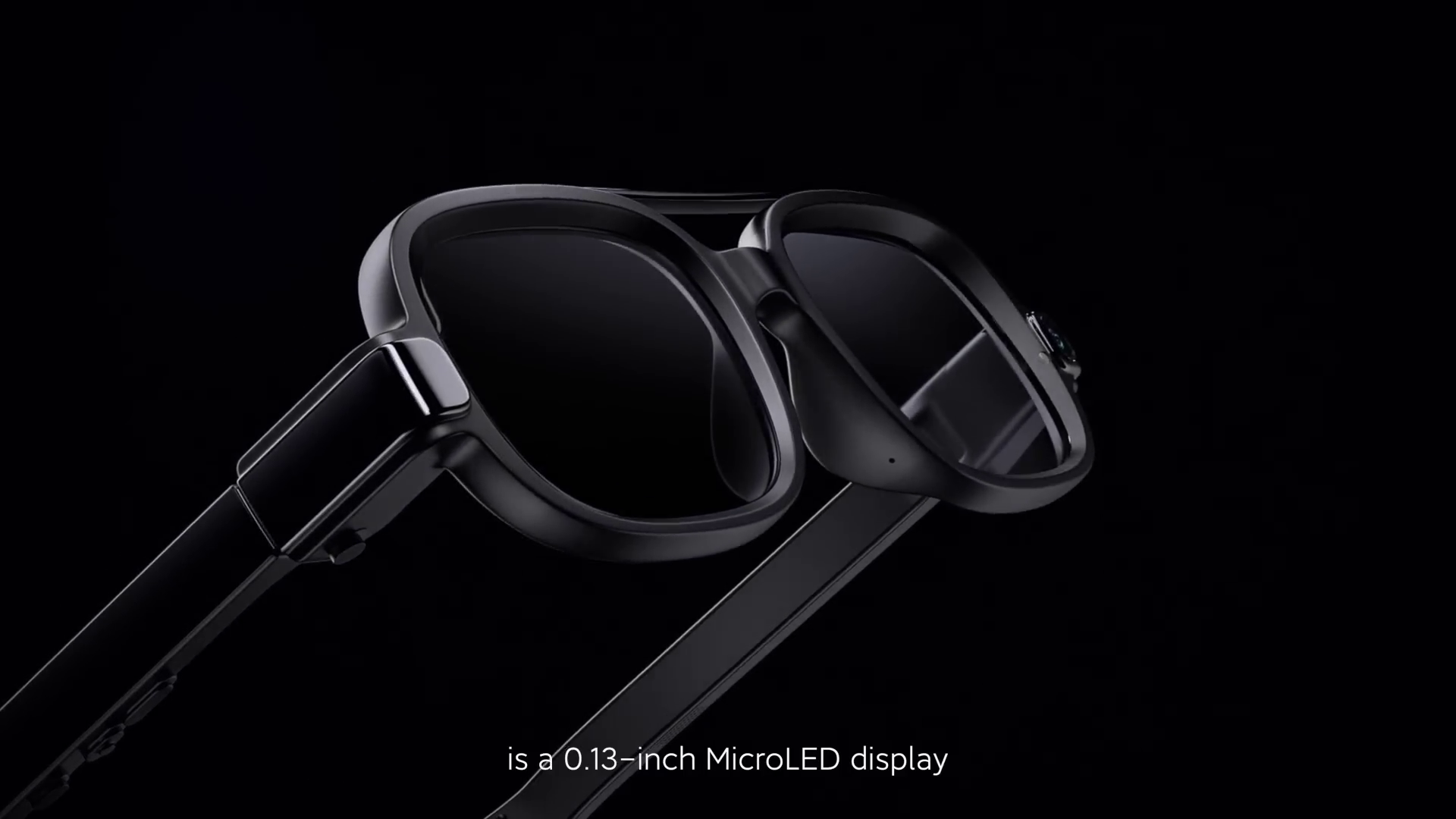
Caption: Exploded view of the sensor stack utilizing optimized Computer-Aided Design data to demonstrate internal complexity.
2. Visualizing Scale: The MicroLED Challenge
Goal: To communicate the microscopic size of the display chip (2.4mm x 2.02mm).
Process: A simple close-up wasn't enough to convey scale. Advids conceptualized a comparison shot involving a single grain of rice. We modeled a photorealistic rice grain using organic displacement maps to contrast with the sharp, engineered lines of the MicroLED chip.
Action: The lighting team had to simulate the emission of "2 million nits" of brightness from the chip, using a high-dynamic-range emission channel that bloomed correctly into the virtual camera lens.
!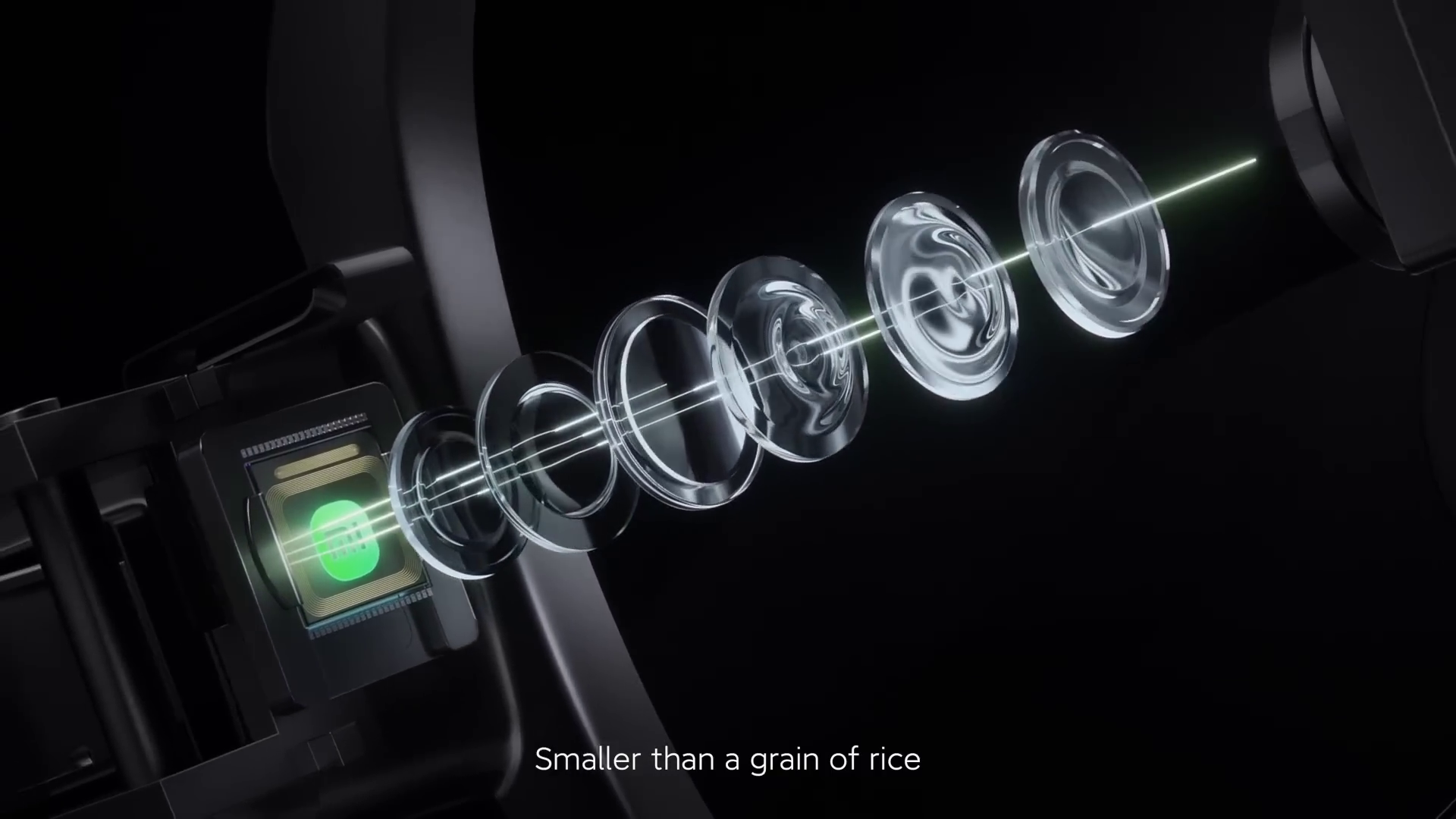
Caption: The "Grain of Rice" comparison shot, establishing the extreme miniaturization of the MicroLED component.
3. Critical Juncture: Visualizing the Invisible Waveguide
Challenge: The core technology—Optical Waveguide—involves light bouncing through microscopic structures inside the lens. In reality, this process is invisible. The client needed to show the path of the light to explain how the image reaches the eye.
Constraint: Standard ray-tracing renders light accurately (invisibly). We needed to stylize physics.
Solution: Advids developed a custom particle simulation using Waveguide_Light_Sim_Cache_v05.abc. We created a volumetric fog pass inside the lens geometry and used an emitter to shoot "photons" through the waveguide structure. By accelerating the light particles and adding a "trail" renderer, we visualized the reflection and diffusion process (the "sawtooth" pattern) in a way that felt scientific rather than magical.
!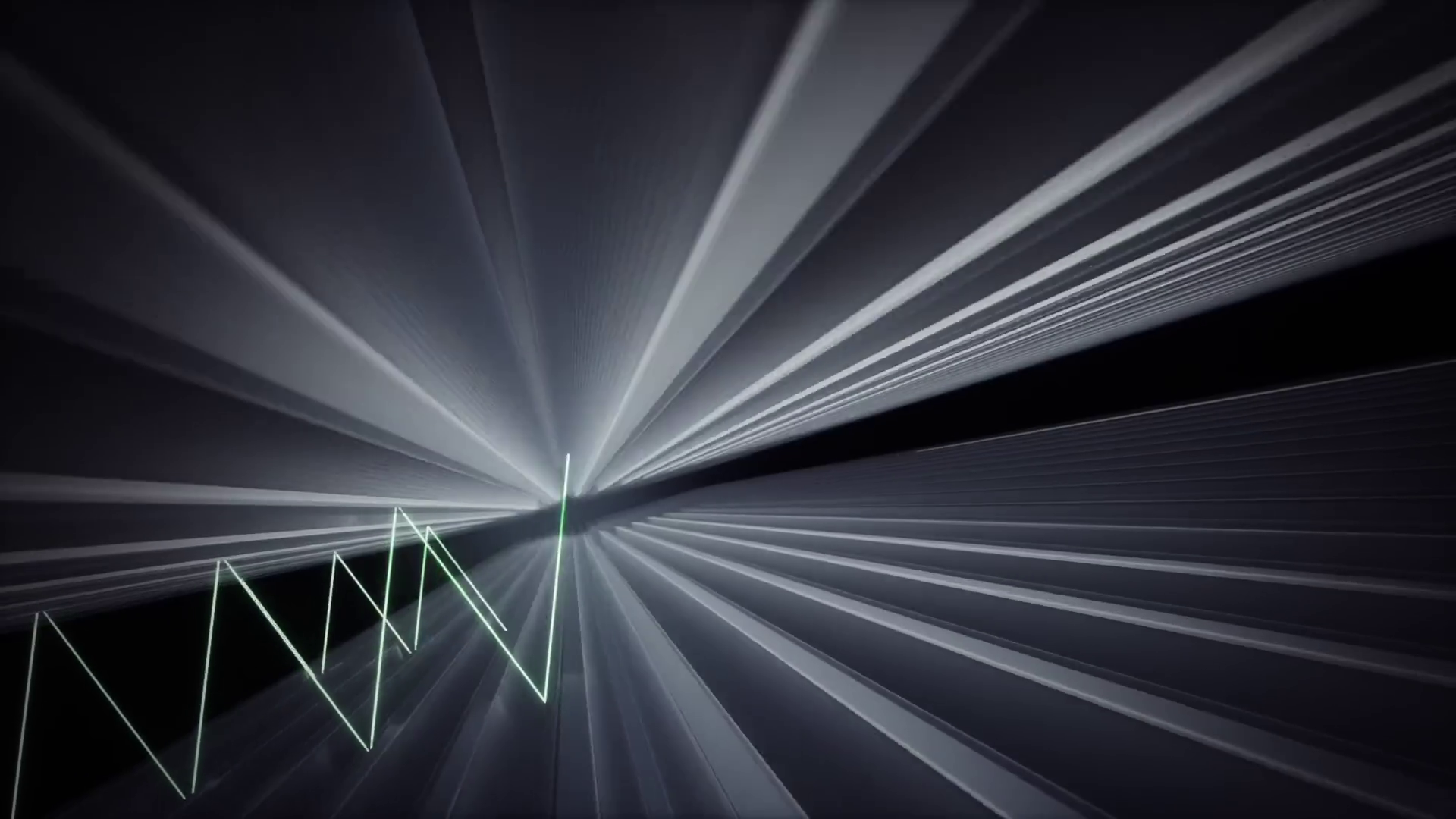
Caption: The custom particle simulation visualizing the reflection and diffusion of light within the Optical Waveguide lens.
4. Mixed Reality Compositing and Matchmoving
Goal: To show the User Interface (UI) in a real-world context.
Process: The client provided live-action Point-of-View footage. Advids was responsible for integrating the green holographic interface. This required rigorous "Matchmoving" (3D camera tracking) to ensure the navigation arrows and notification bubbles stayed "locked" to the environment as the wearer's head moved.
Action: We designed the UI elements with a specific "monochrome green" palette to match the MicroLED specifications. In the composite (POV_Navigation_Comp_v12.aep), we added subtle optical imperfections—like edge distortion and transparency falloff—so the graphics felt like they were projected in the glass, not just overlaid on the video.
Feedback Loop: Refining the Mixed Reality Aesthetic
Client: "The navigation arrows look too solid. They obscure the road too much, which looks unsafe."
Advids: "We adjusted the alpha channel opacity on
UI_Nav_Arrow_v03.pngand added an 'Additive' blend mode. This allows the texture of the road to be visible through the arrow, reinforcing the Augmented Reality feel."
![IMG ASSET 4]
Caption: The final composite showing the navigation interface locked to the environment via 3D matchmoving.
Synergy Analysis
This project exemplified the synergy between Technical Rigor and Creative Storytelling.
- Technology: The use of high-end simulation tools allowed Advids to visualize invisible light physics and microscopic components that traditional cameras could not capture.
- Human Expertise: The Advids creative team’s ability to interpret engineering constraints—such as the monochrome nature of the display—ensured the visual output was not just beautiful, but technically accurate to the product's actual capabilities.
Outcomes & Strategic Learnings
The final video served as the cornerstone of Xiaomi's concept announcement.
- Clarity: The video successfully explained the "Waveguide" technology, a concept previously difficult for general consumers to grasp.
- Engagement: The seamless transition between the microscopic 3D world and the macroscopic live-action world kept viewer engagement high throughout the runtime.
- Strategic Learning: For future Mixed Reality projects, Advids identified that "imperfection" is key to realism. Adding simulated optical flaws to the holographic elements made them feel more integrated and believable than perfect, sharp digital graphics.
Would you like me to analyze how this "Precision Visualization" workflow could be adapted for a medical device or biotechnology explainer video?
Final Video
Author & Editor Bio