

Video Marketing

The AI Startup Launch Video Playbook: Teaser, Launch and Proof From Stealth to Series A

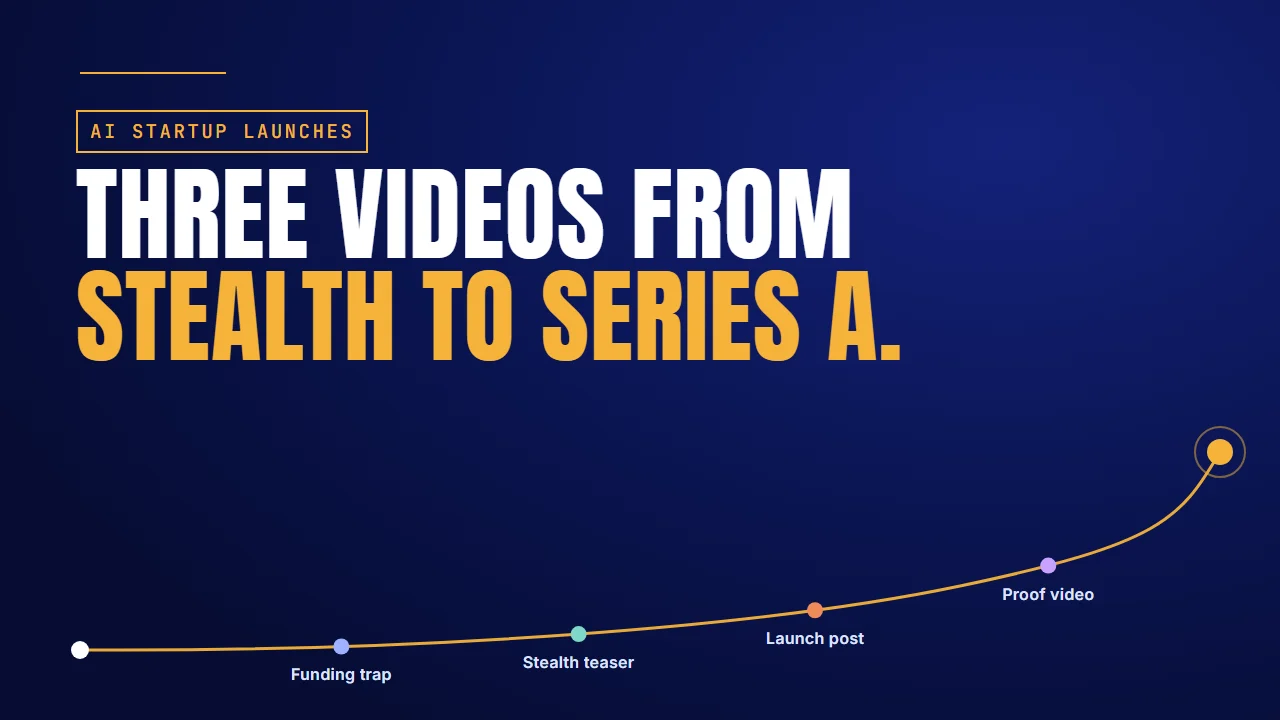
Three videos from stealth to Series A: funding trap, stealth teaser, launch post, proof video

Why it matters

One launch post, three kinds of proof

On 12 March 2024, a startup most people had never heard of published one blog post. The startup was Cognition and the product was Devin, an AI software engineer. The post held a benchmark result, seven short videos of the product doing real work, and a funding round. In that order.

On the pageWhat Cognition published
A claim anyone could checkDevin resolved 13.86% of SWE-bench issues end to end
The comparisonPrevious best: 1.96%
The fine printTested on a random 25% subset of SWE-bench
The videosSeven short task videos, each with one job
The money, placed lastA $21 million Series A led by Founders Fund

The 13.86% is Cognition's own reported result, not an independent test. What matters for your launch is the packaging: proof first, money last, and every claim something a reader could check for themselves.

The short answer: an AI startup needs three videos on the road to Series A. In stealth, a teaser about the problem and the founder's why. At launch, a checkable claim above short task videos, with the funding last. After launch, one customer's result. Each section below includes a video we made that shows the move.

Planning your launch videos?

Talk to the Advids team about what to show in stealth, at launch and on the road to Series A.

Let’s talk

Funding trap

A funding headline is not a launch

A funding number tells people investors believe in you. It doesn't help a buyer believe in you.

Most AI startups come out of stealth the same way: a press release, a logo and a funding number. The number proves investors are excited. A buyer needs something else.

Alessandro Cutri, who runs paid acquisition for B2B tech companies, puts it well. A B2B buyer can lose their job over a bad vendor choice, so they need justification, not hype. AI buyers are sceptical by default. A funding headline is excitement. A video of the product working is justification.

So treat the funding news as the last line of the story, not the first. CXL's guide to a launch marketing plan starts from what the buyer needs to hear, and so should your videos.

Earth Token: the case first, the ask last

Our explainer for Earth Token, a token tied to natural assets, doesn't open on the token. It opens on a market that wants to fund green projects, then names the gap: connecting buyers and sellers "has always been difficult and inefficient". One forest carries the model, kept standing instead of cut, with the community paid in tokens. Only at the end does it ask viewers to invest. See how we made it.

What works here:

  • The gap is named before the product appears.
  • One simple example carries the model, so a viewer can retell it.

The move: Write the justification your buyer needs to defend the choice, and put the ask after it.

Justification has to start before anyone can see the product. So what do you show in stealth?

Stealth teaser

In stealth, show the problem and the founder's why

Not the product. The problem, and the person solving it.

Video producer Fraser Cottrell breaks a founder video into three beats. Use them as the script for a stealth teaser.

BeatWhat the founder says
Why we startedThe problem they kept running into
What's differentHow they see the fix differently
Why it matters to youWhy they'd recommend it to someone like the viewer

Cottrell also points out that the founder doesn't have to be on camera. A voice-over on visuals works too, which helps when your founder is busy shipping. Jonathan Rintala's guide shows how to build your founder story into go-to-market work.

Keep it short and post it where your future buyers already are. The goal isn't sign-ups yet. It's a waitlist of people who recognise the problem. Our guide to startup teaser videos covers formats and lengths.

Talentium TED: a name and a category, no product screen

Our teaser for TED, Talentium's AI assistant for recruiters, shows no product at all. White words build "The future of hiring is here". A glossy 3D star settles into the TED mark. One category line follows, "The fully automated recruiting platform", then "We are here to change things!" The address holds on screen for the last six seconds. See how we made it.

What works here:

  • The buyer's topic, hiring, comes before the brand.
  • Three things to remember: the name, the category, the address.

The move: Before the product can be shown, give people a name, a problem and a place to sign up.

One more thing: record your founder now, even if you won't use the footage for months. The founder story sounds most honest before the launch noise starts, and you'll reuse those lines in every video that follows.

Then comes the big moment. Back to that Cognition post, because its structure is one you can copy.

Launch post

At launch, put a checkable claim above short task videos

Proof first, money last. The funding confirms the story; it doesn't tell it.

Look at the order in Cognition's launch post, "Introducing Devin". First, a claim you can check: a benchmark score against the previous best, with the test set stated. Second, the videos. Not one big sizzle reel, but seven short clips, each with one job. Devin learns an unfamiliar tool. Devin builds and deploys an app. Devin finds and fixes a bug. Each title is a promise, and each clip proves it.

Third, and only at the end of the post, Cognition named the money: a $21 million Series A led by Founders Fund. The funding didn't sell the product. The videos did, and the funding confirmed it.

LogicListerAI: one tool, one screen, one output

Our reveal for LogicListerAI was made before launch: its homepage on screen reads "ProductHunt Coming Soon". The app does many jobs, so the video names the categories first. Then each tool gets one labelled screen with a real output: product descriptions from three seed words, a full article, code filling a dark panel, a finished image, a PDF chat. It ends on "Try it For Free". See how we made it.

What works here:

  • Each tool gets its own screen and its own label, like a one-job task clip.
  • Every screen ends on a result, not a menu.

The move: List what your product does, give each task its own short clip, and show the output every time.

Here's how to plan your own version, as an example. GTM Buddy's B2B SaaS launch checklist is a good companion for the rest of launch week.

StepWhat to do
1. Pick the tasksList the five tasks your product does better than anything else
2. Record each oneOne clip per task, start to finish, 30 to 60 seconds, no cuts that hide the waiting
3. Title each clipWrite the title as a promise the clip then proves
4. Lead with a numberPut the hardest number you have right above the clips
5. Put the funding lastClose with the round, after the proof

For more ideas on structure, browse our AI launch videos collection.

That's the launch. But launch buzz fades in a week. What carries you to Series A is proof.

Proof video

On the road to Series A, let one customer's result talk

Your best video after launch isn't about your product. It's about one customer.

Between launch and Series A, show one customer's workflow before, their workflow after, and the one number that changed. Here's an example, not client data: say you sell an AI tool for legal teams.

BeatWhat the viewer sees
BeforeA legal team's contract review takes three days
AfterThe same review, done in one afternoon with your AI tool
The numberTheir lawyer says the change in their own words

That one video works for three audiences. Investors see traction they can verify. Buyers see someone like them. Candidates see a product that people actually use. Mercury's guide to storytelling for fundraising makes the same case for investors: one concrete story beats a list of claims. Our collection of AI customer success stories shows the format at work.

Cognata: the same tests, with partners' names on screen

Our video for Cognata's Automated Driving Perception Hub, a sensor simulation program, opens on a partner card with Microsoft and AMD. Then five sensor makers, from Lidwave and Innoviz to ADASKY, each run through labelled test scenes in the same simulation: "Static Object Detection: Dropped Tire", "Harsh Weather, Night, Crossing Deer". Each scene carries the partner's logo and shows what its sensor picks up. See how we made it.

What works here:

  • The proof carries other companies' names, not only Cognata's.
  • Every test is labelled, so a viewer knows exactly what was shown.

The move: Let someone else's name sit next to the result. Label the test so the viewer can judge it.

Three stages, three videos. Here's where to start, depending on where you are.

Where to start

Where to start

The short answer: start from the stage you're in, and record the founder now whatever it is.

If you areMake this videoShowLeave outExample to copy
About to announce a roundFunding trapThe problem and why your fix worksFunding as the headlineEarth Token
Still in stealthStealth teaserThe problem, the founder's why, a waitlistThe productTalentium TED
Launching this monthLaunch postA checkable number above five task clipsA sizzle reelLogicListerAI
Raising your Series AProof videoOne customer, before and after, one numberFeature listsCognata

If investors are the first audience, our startup launch video guide covers the full plan. Or see the AI and ML teams we've made video for.

FAQ

Questions about AI startup launch videos

What video should an AI startup publish while still in stealth?
A short teaser about the problem and the founder's reason for solving it. Skip the product. The goal is a waitlist of people who recognise the problem.
Does the founder have to appear on camera in a teaser?
No. Fraser Cottrell notes a founder video can be a voice-over on visuals. That helps when the founder is busy shipping, as long as the story is theirs.
Why put the funding news last in a launch post?
Funding shows that investors believe; it doesn't help a buyer believe. Cognition's Devin post put the benchmark and task videos first, and the Series A last.
How long should each launch task video be?
Keep each clip to one task, start to finish. We suggest 30 to 60 seconds, with no cuts that hide the waiting, and a title that states the promise.
What makes a proof video work for investors and buyers at once?
One real customer, their workflow before and after, and the one number that changed. Investors see traction, buyers see a peer, candidates see real use.
Can one founder recording be reused across all three videos?
Yes. Record the founder's why early, before launch noise starts. Those lines can open the teaser, frame the launch post and introduce the customer proof later.

About the author

About Jai Ghosh

Video Producer at Advids · LinkedIn

Jai Ghosh is a Video Producer at Advids, where he has planned and produced videos for B2B software and technology companies for 7 years. He works on product demos, explainer videos and brand videos, from the first script to the final cut, for clients from startups to enterprises.

Before Advids, Jai spent over 11 years in freelance media consulting, after starting out in digital journalism. He writes the Advids blog's breakdowns of product and demo videos, sorting real examples by the question each one answers for a buyer.

  • Focus: SaaS product demos, explainer videos and brand videos
  • Experience: 7 years at Advids, over 11 years in media consulting
  • Background: digital journalism

Connect with Jai Ghosh on LinkedIn

Sources

Sources