

Video Marketing

How Deep Tech Brands Use Video in Go-to-Market: Prove It, Explain It, Improve It

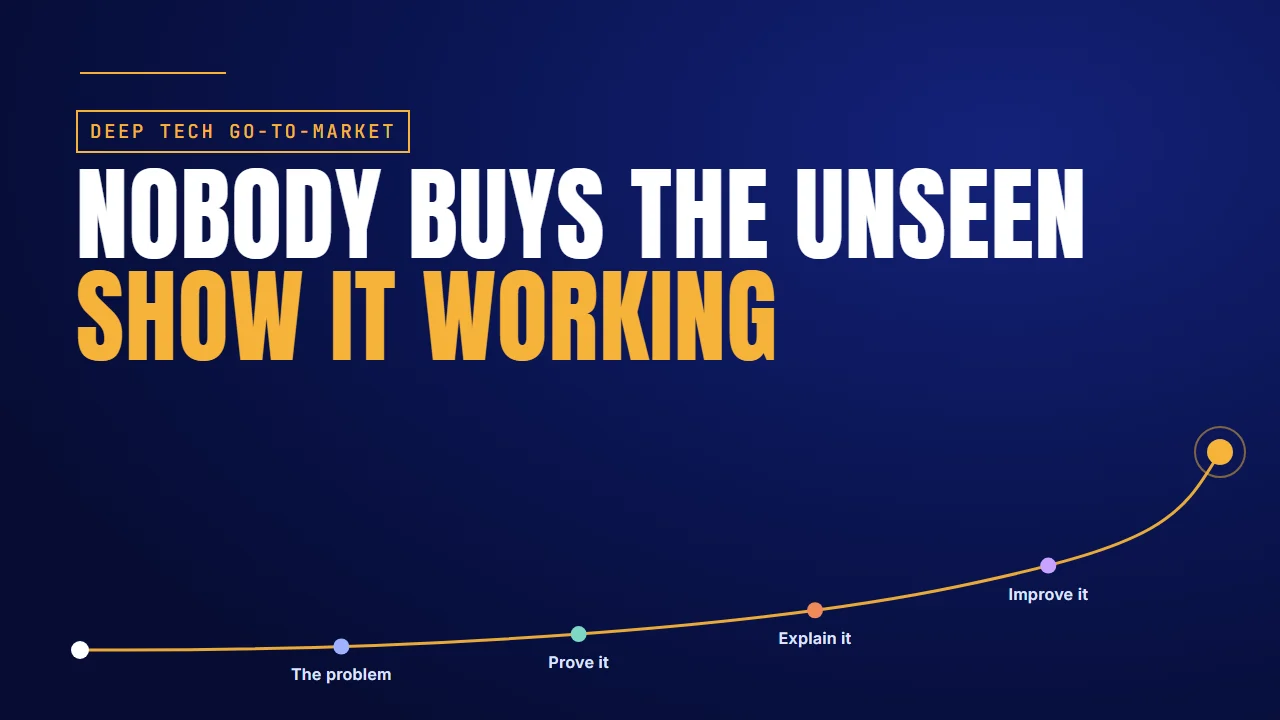
Deep tech go-to-market: nobody buys the unseen, show it working

Why it matters

Why the robots dance

Boston Dynamics has spent years putting videos of its robots dancing online. For a lot of people, those videos are the company. The company says so itself: many people know its robot mostly from viral videos.

Ask its engineers why they do it, and the answer is surprising. Roboticist Eric Whitman calls dancing "a form of highly accelerated lifecycle testing for the hardware." The brands that get video right don't bolt it on at the end. They use it much earlier than you'd think.

What Boston Dynamics saysWhere it says it
Dancing is "highly accelerated lifecycle testing for the hardware"All Together Now
A dance gives developers a creative target that leads to rapid innovation in how the robot movesAll Together Now
Dance testing showed too much knee force could cause damage, so the team looked for better upper-leg materialsAll Together Now
"People's attitudes change once they get to see the robot in person"Spot Takes the Stage
Many people know the robot mostly from viral videosSpot Takes the Stage

Both are posts on Boston Dynamics' own blog. The company publishes no sales figures tied to its videos, and we don't claim any.

The short answer: deep tech video has three jobs. Prove the product works with real footage. Explain what the camera can't see with honest animation, starting from the outcome. Then use an ambitious demo as a target for the product itself. Each section below includes a video we made for a hardware or deep tech client.

Planning video for a deep tech launch?

Talk to the Advids team about proof footage, mechanism animation and the order that ties them together.

Let’s talk

The problem

Deep tech can't be sold on a spec sheet

Your product sounds impossible, invisible, or both.

A robot that walks across a factory. A battery chemistry. A chip that moves data with light. Your buyer, your investor and your next hire all ask the same question: does it actually work?

The usual answer is a spec sheet full of jargon. Alessandro Cutri, who runs paid acquisition for B2B tech companies, found the cost of that with complex enterprise software. When his ERP campaigns used the technical category name, performance dropped. People don't buy the thing. They buy the outcome the thing produces. So drop the jargon from the first seconds and lead with the result.

That's why the best technology ads start with what changes for the buyer, not with what the product is called.

AM-Flow: the outcome before the jargon

Our promo video for AM-Flow, which automates the steps after 3D printing, draws the cost before naming it. Each new printer brings its own rows of workers at conveyors, and their heads turn red. Then the workers are gone, and one machine marked "AM-FLOW" holds the line. Only after that do claims appear in text, such as "Cuts labor by 90%". See how we made it.

What works here:

  • Until the claims, the only words on screen are small labels, so the pictures carry the argument.
  • The fix appears in the exact spot where the problem lived.

The move: Show the outcome your buyer wants, or the cost they live with, before any category name or spec.

So deep tech video has three jobs. The first is proof.

Prove it

Proof footage is the test drive for buyers who can't visit

The first job is proof: the real thing, working, in the real world.

One Boston Dynamics team member put it simply: people's attitudes change once they get to see the robot in person. For most of your buyers, video is the closest they'll get to in person.

Think of it like a test drive. Nobody buys a car from the brochure. Proof footage is the test drive for buyers who can't visit your lab or your plant.

So resist the urge to over-edit. Long takes, real environments and a visible timestamp beat a slick montage, because skeptical buyers look for the cut. The strongest hardware demo videos let a task run from start to finish in one shot.

AMD Instinct MI300: every claim traceable

Our 3D launch video for the AMD Instinct MI300 Series puts each spec on the part that delivers it. "Sharing 128 GB HBM3 Memory" lights up the memory stacks, and the MI300X platform builds from one accelerator to eight on a board. The biggest claims carry markers on the same frame, such as "*MI300-26. See Endnote 1". See how we made it.

What works here:

  • A data center engineer can trace every superlative to its endnote.
  • Each product gets its own named block, so four launches don't blur into one.

The move: If you can't show the product in a real place, make every claim checkable on screen instead.

Proof footage has a limit, though. A camera can't see inside a battery, a reactor or a chip.

Explain it

Animate what the camera can't see, then cut back to the product

The second job is explanation. Use animation for the mechanism, and keep it tied to the outcome.

Here's the order that works. Start with the outcome the buyer cares about. Then animate the one mechanism that makes it possible. Then cut back to real footage of the product. Outcome, mechanism, proof.

Keep the animation honest. Show the mechanism as it really works, not a glowing fantasy version. Your engineers will be watching, and so will your buyer's engineers. Done well, exploded and x-ray views answer the question a spec sheet can't.

BeatIllustration: a new batteryWhat it does
OutcomeA warehouse robot running a full double shiftShows what the buyer gets
MechanismA zoom into the cell, showing why it doesn't overheatExplains how it's possible
ProofBack to the robot, still running at hour sixteenTies the mechanism to the real product

That battery is an example, not client data. The order works for any product whose key part is hidden. It's also how good teams explain technical information to buyers in writing.

Kurtz Ersa Flying Ray: inside the sealed chamber

Our 3D product video for the Kurtz Ersa Flying Ray, a metal 3D printer, starts with the whole plant and an operator on its platform. Then the camera drops inside the sealed chamber. Several laser beams trace rings in the powder at the same time, a part takes shape in a see-through world, and an x-ray view shows it buried in the bed. It cuts back to the full plant and an operator at the control panel. See how we made it.

What works here:

  • The animation goes only where a real camera can't: inside the chamber and under the powder.
  • Every inside view returns to the real machine, so the mechanism stays tied to the product.

The move: Animate the one mechanism a camera can't reach, then cut straight back to the product a buyer would install.

So that's proof and explanation. The third job is the one most deep tech teams miss.

Improve it

Let the demo set a target for the product

The third job: use an ambitious demo as a target for the product itself.

Back to those dancing robots. Boston Dynamics says a dance gives developers a creative target that leads to rapid innovation in how the robot moves. Dance testing showed that slamming the robot's knee with too much force could damage it. So the company went looking for better materials for the upper legs.

The video isn't only marketing at the end of the pipeline. Planning a demo forces your team to make the product do something hard, on camera, reliably. Whatever breaks on set is something you fix before a customer finds it.

So write the demo early. Pick one task that would impress your toughest buyer, and let the engineering team sketch it out before anyone builds a frame.

Stellantis STLA Medium: targets on screen

Our 3D animation for Stellantis' STLA Medium EV platform builds the platform from its parts and puts each commitment in a caption on the part behind it: "More than 700 km (435 miles) WLTP" on the battery, "Consumption Less Than 14 kWh/100 km" on the high-voltage hardware, and "Goal: Maximize Range". Later captions read "Over-the-Air Updates Will Extend Platform Life" and "Up to 2 Million Vehicles Per Year". See how we made it.

What works here:

  • Every number sits on the hardware that has to deliver it.
  • One caption is written as a goal, "Maximize Range", not as a finished result.

The move: Put the hard targets on screen, on the part that must meet them. Planning those captions early shows which numbers the product can already back up.

Prove, explain, improve. Which one you start with depends on the question your buyer asks first.

Where to start

Where to start

The short answer: start from the question your buyer asks first.

If your buyer asksJobFootageExample to copy
What do I get from this?Lead with the outcomeThe cost or result, drawn before any specAM-Flow
Does it actually work?Prove itReal footage, long takes, claims you can traceAMD Instinct MI300
How does it work?Explain itHonest animation of one mechanism, then the real productKurtz Ersa
Can it really hit that number?Improve itA demo planned as a target, numbers on the partsStellantis

Most deep tech companies need all three across a launch, and many 3D tech explainers mix animation and live action in one cut. We've made video for hardware and deep tech teams such as AMD, Stellantis, Kurtz Ersa and AM-Flow. See the deep tech teams we've made video for.

FAQ

Questions about deep tech video

Should deep tech videos use real footage or animation?
Both, in order. Real footage proves the product works. Animation explains the mechanism a camera can't see. Then cut back to the real product so the two connect.
How do you make proof footage that buyers believe?
Show the real product in a real place, in long takes, with a visible timestamp. Resist over-editing, because skeptical buyers look for the cut and distrust a montage.
What order should a deep tech explainer follow?
Outcome, mechanism, proof. Open on what the buyer gets, animate the one mechanism that makes it possible, then return to real footage of the product working.
How accurate does a 3D mechanism animation need to be?
Accurate enough for your buyer's engineers. Build from CAD where you can, show the mechanism as it really works, and audit the physics before the video ships.
Can a product video help the engineering team, not only sales?
Yes. Boston Dynamics uses dance videos as hardware testing. A hard demo gives engineers a target, and whatever breaks on set gets fixed before customers see it.
Which video should a hardware startup make first?
Usually proof footage of the product doing one real task. It answers the first question every buyer, investor and hire asks: does it actually work?

About the author

About Jai Ghosh

Video Producer at Advids · LinkedIn

Jai Ghosh is a Video Producer at Advids, where he has planned and produced videos for B2B software and technology companies for 7 years. He works on product demos, explainer videos and brand videos, from the first script to the final cut, for clients from startups to enterprises.

Before Advids, Jai spent over 11 years in freelance media consulting, after starting out in digital journalism. He writes the Advids blog's breakdowns of product and demo videos, sorting real examples by the question each one answers for a buyer.

  • Focus: SaaS product demos, explainer videos and brand videos
  • Experience: 7 years at Advids, over 11 years in media consulting
  • Background: digital journalism

Connect with Jai Ghosh on LinkedIn

Sources

Sources