

Video Marketing

LinkedIn Video Ads for Enterprise Buyers: Five Frameworks That Last a Long B2B Deal

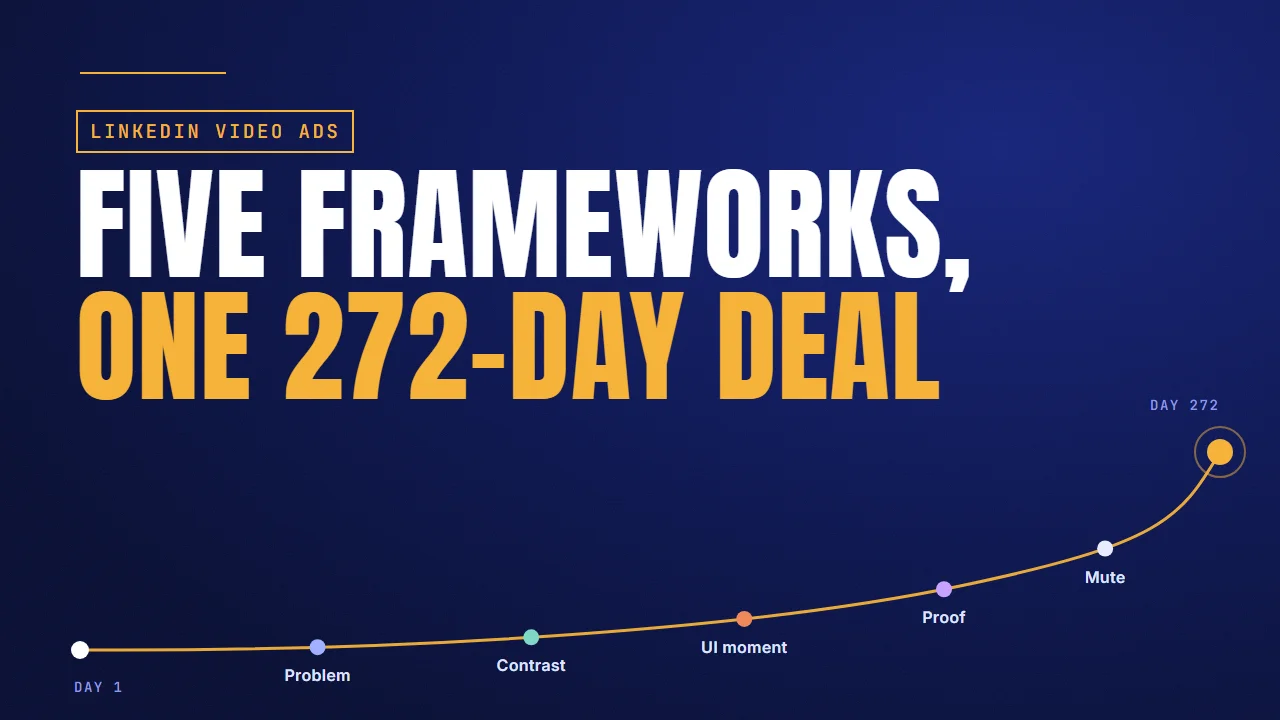
Five frameworks, one 272-day deal: LinkedIn video ads for enterprise buyers

Why it matters

Your ad has to last a 272-day deal

Dreamdata's 2026 benchmark, built on more than 3.5 million B2B buyer journeys, puts LinkedIn first for return on ad spend. The figure covers all LinkedIn ads, not video alone. The same report puts the average journey at 272 days, up from 211 the year before.

ChannelReturn on ad spend, 2025 (Dreamdata)
LinkedIn ads121%
Google Search67%
Meta51%

So the ad that helps win an enterprise deal is the one a buyer still remembers nine months later, not the one they clicked.

Video gives a buyer more to remember. LinkedIn says video ads earn 30% more comments per impression than static images, and its 2025 B2B Marketing Benchmark found 12% more B2B advertisers using video than a year earlier. Static images still have a job in retargeting.

The short answer: make one problem hurt before the fix, contrast the old way instead of a rival, animate the one product moment that matters, let a customer say the number, and build every ad to work on mute. Then cut all five from one production. Four of the sections below include a video we made for a software client.

Planning LinkedIn video ads?

Talk to the Advids team about which frameworks fit your buyers and how to cut them from one production.

Let’s talk

Problem first

Make one problem hurt before you show the fix

Pick one frustration your buyer lives with, show it, then show the way out.

Alessandro Cutri, who runs paid acquisition for B2B tech companies, keeps it to one problem and one solution per ad. Cram three pains into 30 seconds and the buyer feels none of them.

Zoho Workplace built its LinkedIn campaign this way. It made short office sitcoms of 30 to 40 seconds, each about one frustration: disconnected apps, messy contracts, privacy worries. Each one then showed the fix, one connected workplace. In LinkedIn's case study, Zoho reports a 12% lift in aided brand awareness in the US and engagement 25% above LinkedIn's benchmarks.

Atera: one frustration, scene after scene

Atera's live-action video for its autonomous IT platform follows employees through one problem: IT that keeps failing them. Frozen updates, Wi-Fi trouble, then a queue just to open a ticket. It ends on one line: the system is broken, we fixed IT.

What works here:

  • Every scene shows the same problem, so the frustration builds instead of scattering.
  • The fix arrives in one line, after the viewer has felt the problem.

The move: Choose the frustration your buyer complains about most and give it most of the runtime. Keep the fix to a line and a logo.

Once the buyer feels the problem, the next ad can show what the old way costs next to yours.

Old way vs new

Contrast the old way, not a named rival

Put the old way and yours side by side, and let the buyer do the maths.

Video ad producer Fraser Cottrell points to Apple's Mac versus PC ads as the contrast principle at work. There's no attack, just two things next to each other. The viewer draws the conclusion, so it feels like their own.

Naming a rival is a different move. Ben Heath, who runs a paid ads agency, calls naming a competitor aggressive and says you have to choose how hard to go. In enterprise sales your buyer may already be that rival's customer, so contrast the old way of working instead.

Freshservice: the old way, then another option

Freshworks' launch video for Freshservice, its IT service software, is told entirely in kinetic type. It calls most service software outdated and oversized, full of mind-numbing, morale-sucking blockers. Then it turns: there's another option, with adoption in weeks, not months.

What works here:

  • No competitor is named, so no buyer hears their current vendor attacked.
  • Each side has its own look: heavy type on black for the old way, plain words on white for the new.

The move: Write the old way in your buyer's own complaints, then answer each one. Weeks, not months, is a contrast a buyer can check.

A contrast tells the buyer life gets easier. The next ad has to show the moment it does.

UI moment

Animate the one moment the product does the job

Enterprise screens are busy. Show the one step that does the work, and keep it short.

Real dashboards are full of clutter and client data, so a screen recording shows too much. Rebuild the one moment where the product does the job and cut the rest. LinkedIn's data from 2025 says videos of 7 to 15 seconds saw up to a 300% lift in completion rates.

Jasper, the AI marketing platform, put product videos in the LinkedIn feed and on connected TV during its 2025 rebrand, alongside other ad formats. In LinkedIn's case study, qualified leads rose 226% and cost per lead fell 40%. That's the whole full-funnel campaign, not video alone.

Lusha Playlists: the list, not the whole app

Lusha's launch video for Playlists, its AI prospecting feature, rebuilds the product as clean animated panels: a Ready to buy list of prospects, then a Live list with a toggle and an update frequency.

What works here:

  • Only the feature's own panels appear, with no sidebars or menus around them.
  • Each panel is large enough to read at the size a feed shows it.

The move: Pick the one screen where the product does the job and rebuild it without the clutter. If a panel can't be read on a phone, it's carrying too much.

Showing the product proves it works. Only a customer can prove it worked.

Customer proof

Let a customer say the number

One number, said by the customer, not by you.

An enterprise buyer is taking a career risk. Cutri compares a B2B purchase to buying a house: nobody commits on one photo. That's social proof at work. A peer who says the result out loud lowers the risk more than any claim you make yourself.

Smokeball, a legal practice software company, recorded a three-minute testimonial with its customer Empire Legal. It cut the interview into 30-second clips, horizontal and vertical. The customers posted the clips themselves, and Smokeball promoted those posts as Thought Leader Ads. In LinkedIn's case study, return on ad spend grew 186%.

None of this lands if the buyer can't hear it, and most of them can't.

Sound off

Build every ad to work on mute

Most of your buyers will watch with the sound off.

LinkedIn says almost 80% of its users watch video ads with the sound off. Its video ad tips say to design for silence: show what matters in the first 10 seconds and burn in subtitles.

LinkedIn Creative Labs studied 13,000 B2B video ads. As reported by PPC Land and Search Engine Land, short bulleted captions kept people watching 30% longer, and vertical video earned 34% longer dwell time than square.

Exalate AI Assist: the claim is on screen first

Exalate's explainer for AI Assist opens on text. It introduces AI Assist, then states its promise on screen: integrating your tools shouldn't take a lot of your time. Labels then walk through the steps: Prompt, Review, Publish.

What works here:

  • The promise works with the sound off, before any voice-over.
  • Step labels sit over the interface, so a muted viewer can follow it.

The move: Put your claim in words on the first screen. Then label each step, so a viewer with the sound off can follow the product.

The mute test: watch your ad with the sound off. If you can't tell what it sells within three seconds, neither can your buyer.

Five frameworks sound like five shoots. They don't have to be.

One production

Plan one production and cut it five ways

You don't need five shoots. You need one plan for five cuts.

Plan the cuts before the script. Record the customer interview, rebuild the product moment and write the contrast lines in one production. Then cut each framework from the same files, and test the cuts against each other.

CutBuilt fromLengthWhere it runs
Problem firstThe problem scenes and one fix line30 to 40 seconds, like Zoho'sCold audiences
Old way vs newThe contrast lines in brand typeAbout 30 secondsCold and warm audiences
UI momentThe rebuilt product panels7 to 15 secondsFeature launches, warm audiences
Customer proofClips from the customer interviewAbout 30 seconds, like Smokeball'sRetargeting, Thought Leader Ads
Every cutCaptions, the claim on the first screen, a vertical versionSame as the cutEvery placement

Most of the 200+ LinkedIn ad campaigns we've created were for SaaS brands launching new go-to-market motions with vertical and AI-native ads. Running several frameworks at once only stays affordable when every cut comes from one set of master files, which is how we build them.

Where to start

Where to start

The short answer: start from what your buyer is missing.

If your buyerStart withDo thisExample to copy
Doesn't feel the problem yetProblem firstOne frustration per ad, the fix in one lineAtera
Thinks the old way is fineOld way vs newContrast the old way, name no rivalFreshservice
Can't picture the productUI momentRebuild one screen in 7 to 15 secondsLusha Playlists
Asks who else uses itCustomer proofClips of a customer saying the numberSmokeball's clips
Scrolls past with the sound offSound offClaim on the first screen, captions, verticalExalate AI Assist

We've made video for software teams such as Freshworks, Lusha, Exalate and Atera. See the software teams we've made video for.

FAQ

Questions about LinkedIn video ads

What makes a LinkedIn video ad work for enterprise buyers?
One clear idea per ad, shown in the first frame and readable on mute. Pick one framework, such as problem first or customer proof, and keep the product moment short.
How long should a LinkedIn video ad be?
Aim for 7 to 15 seconds for awareness. LinkedIn reports up to a 300% lift in completion at that length. Save longer cuts, like testimonials, for retargeting viewers.
Do LinkedIn video ads need captions?
Yes. LinkedIn says almost 80% of its users watch video ads with the sound off. Burn in captions, and use short on-screen bullets, which kept viewers watching 30% longer.
Should LinkedIn video ads be vertical or square?
Test vertical. In LinkedIn's study of 13,000 B2B video ads, vertical video earned 34% longer dwell time than square. Keep the claim inside the centre of the frame.
Is video better than a single-image ad on LinkedIn?
Video ads earn 30% more comments per impression than static images, according to LinkedIn. Static still works for retargeting, so use video to open the journey and images to remind.
Should a B2B video ad name a competitor?
Usually not for enterprise. Your buyer may already use that rival. Contrast against the old way of working instead, and let the buyer draw the comparison themselves.

About the author

About Jai Ghosh

Video Producer at Advids · LinkedIn

Jai Ghosh is a Video Producer at Advids, where he has planned and produced videos for B2B software and technology companies for 7 years. He works on product demos, explainer videos and brand videos, from the first script to the final cut, for clients from startups to enterprises.

Before Advids, Jai spent over 11 years in freelance media consulting, after starting out in digital journalism. He writes the Advids blog's breakdowns of product and demo videos, sorting real examples by the question each one answers for a buyer.

  • Focus: SaaS product demos, explainer videos and brand videos
  • Experience: 7 years at Advids, over 11 years in media consulting
  • Background: digital journalism

Connect with Jai Ghosh on LinkedIn

Sources

Sources