 /home/wwwroot/advids.co/design/index.php on line 425
Introduction: Bridging the Physical-Digital Divide
In the high-stakes world of Third-Party Logistics (3PL), moving cargo is only half the battle. The other half is proving it. For modern shippers, visibility is no longer a "nice-to-have" add-on; it is the currency of trust. Yet, a massive disconnect remains between the physical efficiency of moving goods and the digital clarity of tracking them. We call this the "Physical/Digital Divide." While your trucks and ships may be operating at peak performance, if your client’s dashboard is a black box, the perception is one of chaos.
The data confirms this urgency. The global supply chain visibility market size currently stands at USD 6.3 billion, reflecting a massive industry-wide shift toward digital transparency. Shippers aren't just buying transportation; they are buying certainty. Conversely, the cost of opacity is staggering. Supply chain disruptions cost organizations an average of 184 million U.S. dollars per year—losses that are often preventable with better predictive visibility.
This guide is your strategic blueprint for closing that gap. By leveraging the right video visualization styles, you can translate complex operational data into a compelling narrative of control, efficiency, and reliability. We are moving beyond generic stock footage of forklifts. We are entering the era of "Visual Intelligence"—where your software’s interface becomes your strongest sales asset.
Here is how to visualize the future of logistics.
1. Style 4: Hybrid: Kinetic Typography + Flat
TOFU | Brand Awareness

The Visual & Narrative Approach
Visualization Scenario: Imagine a chaotic scattering of vector blocks—representing fragmented data, lost emails, and unorganized spreadsheets—floating aimlessly on a clean white background. Suddenly, a magnetic force pulls them together. They snap into a rigid, cohesive grid, spelling out powerful words like "VISIBILITY," "CONTROL," and "SPEED."
Narration Style: Fast-paced, rhythmic, and percussive. The sound design should feature "clicks" and "snaps" as the text locks into place, emphasizing the transition from disorder to order.
Psychological Impact & KPI Focus
Niche Psychology: This style addresses the "cognitive load" of logistics managers who are drowning in unstructured data. It visually demonstrates the core promise of a Visibility Platform: imposing order on chaos.
Operational Impact: It instantly communicates the concept of Data Normalization. Just as the blocks align to form a readable word, your platform aligns disparate carrier signals (EDI, API, GPS) into a single source of truth.
Strategic Implementation & Trade-offs
Best Use Case: 15-second social media teasers (Instagram Reels, LinkedIn Auto-play) designed to stop the scroll.
Strategic Trade-off: This style is excellent for concepts but poor for features. It builds hype but doesn't explain how the software works. Use it to grab attention, not to train users.
Companies using similar video content -
Project44 – Movement by Project44 – Unifying global transportation data for clarity.
FourKites – Visibility Platform – Consolidating real-time freight data into order.
2. Style 7: Abstract 2D Organic Modern
TOFU | Category Creation

The Visual & Narrative Approach
Visualization Scenario: We see a fluid, living network of colorful, glossy shapes (as seen in the reference image) that morph and adapt. Unlike rigid grid lines, these organic shapes flow around obstacles, representing a supply chain that "heals" itself. The nodes connect via thin, elastic lines that stretch but never break, symbolizing resilient carrier relationships.
Narration Style: Smooth, sophisticated, and forward-looking. "Supply chains aren't static; they are living ecosystems."
Psychological Impact & KPI Focus
Niche Psychology: Modern logistics is volatile. This style resonates with the desire for agility. It moves away from the "industrial/mechanical" look of legacy logistics towards a "modern/tech-forward" aesthetic.
Operational Impact: It visualizes Interoperability. The fluid connections represent API integrations that are flexible and robust, rather than brittle connections that break when a carrier changes their system.
Strategic Implementation & Trade-offs
Best Use Case: High-level "Vision" videos on your homepage or keynote presentations introducing a new paradigm (e.g., "Logistics 4.0").
Strategic Trade-off: It is highly abstract. If your audience consists of operational managers who want to see the specific "button" to press, this style may feel too "marketing-fluff." Balance it with concrete UI shots later in the funnel.
Companies using similar video content -
E2open – Network Platform – Connecting global trading partners seamlessly.
One Network Enterprises – Real Time Value Network – Building a multi-party business network.
3. Style 2: 2D Line Art Animation
TOFU | Market Education

The Visual & Narrative Approach
Visualization Scenario: A single, continuous black line draws the journey of a package. It starts as a factory, morphs into a truck, transforms into a ship crossing waves, becomes a plane, and finally resolves into a package at a doorstep. The line never breaks, symbolizing the unbroken chain of custody.
Narration Style: Educational, clear, and unassuming. The focus is purely on the concept of "End-to-End" flow.
Psychological Impact & KPI Focus
Niche Psychology: This style reduces Cognitive Load to the absolute minimum. For skeptical prospects who think implementation is "too complex," this visual simplicity is disarming and reassuring.
Operational Impact: It creates a visual metaphor for the Digital Thread. Despite the complexity of multimodal handoffs (truck-to-rail-to-ship), the data stream (the line) remains continuous and uninterrupted.
Strategic Implementation & Trade-offs
Best Use Case: Explainer videos on "How it Works" pages, specifically for explaining complex multimodal routing to non-technical stakeholders.
Strategic Trade-off: It lacks "weight" and "enterprise polish." It can look cheap if not executed with high-quality, smooth animation curves. Avoid using this for high-ticket enterprise sales pitches where "gloss" equals value.
Companies using similar video content -
Shippeo – Real-Time Transportation Visibility – Visualizing unbroken shipment journeys.
Tive – Solo 5G Trackers – Tracing package journey with continuous data.
4. Style 11: Abstract 3D AI Visualization
TOFU | Brand Perception

The Visual & Narrative Approach
Visualization Scenario: A cinematic camera pans over a digital landscape of glowing blue nodes and connecting data streams (referencing the image). We see pulses of light traveling through the network, representing real-time data flow. Some nodes light up in anticipation of the flow—visualizing "Predictive Analytics."
Narration Style: Tech-heavy, authoritative, and futuristic. Use terminology like "Neural Networks," "Predictive Modeling," and "Machine Learning algorithms."
Psychological Impact & KPI Focus
Niche Psychology: This appeals to the Innovator persona. It positions your platform not just as a tool, but as a "Supercomputer" for logistics. It signals that your backend technology is cutting-edge.
Operational Impact: This is the best way to visualize Artificial Intelligence. Since you cannot "see" an algorithm, you must visualize its effect: a glowing, intelligent network that anticipates disruptions before they happen.
Strategic Implementation & Trade-offs
Best Use Case: LinkedIn background videos and header sections for "AI features" or "Predictive Analytics" product pages.
Strategic Trade-off: It can feel cold and impersonal. Ensure the voiceover connects this high-tech visualization back to a human benefit (e.g., "So you can sleep soundly while the AI watches the road").
Companies using similar video content -
FreightWaves – SONAR – Predicting freight market trends with AI.
Windward – Maritime AI Platform – Predicting maritime risks and events.
5. Style 6: Dynamic Data Visualization
TOFU | YouTube Search

The Visual & Narrative Approach
Visualization Scenario: Bar charts rise rapidly, and line graphs trend upward in bright green, overlaying a subtle background of server racks (as seen in the image). The numbers don't just sit there; they count up rapidly. We see "Logistics Efficiency" hitting 98% and "Delivery Times" dropping.
Narration Style: Data-driven and results-oriented. "We don't just track; we optimize. See a 20% reduction in detention costs."
Psychological Impact & KPI Focus
Niche Psychology: This speaks the language of the CFO. It moves the conversation from "features" to "ROI." It visually validates the investment by showing the "up and to the right" trajectory that every executive wants to see.
Operational Impact: It highlights KPI Management. It visualizes the intangible benefits of the software (time saved, cost avoided) in a concrete, undeniable format.
Strategic Implementation & Trade-offs
Best Use Case: Case study videos and "Results" sections of the website. Excellent for establishing credibility in the first 30 seconds of a sales call.
Strategic Trade-off: It relies on generic graphics. To make it effective, you must use realistic numbers that reflect actual industry benchmarks, otherwise, it looks like a template.
Companies using similar video content -
Coupa – Business Spend Management – Visualizing savings and spend efficiency.
Blue Yonder – Luminate Platform – Driving measurable supply chain performance.
7. Style 19: Rapid UI Montage
TOFU | Pre-Roll
The Visual & Narrative Approach
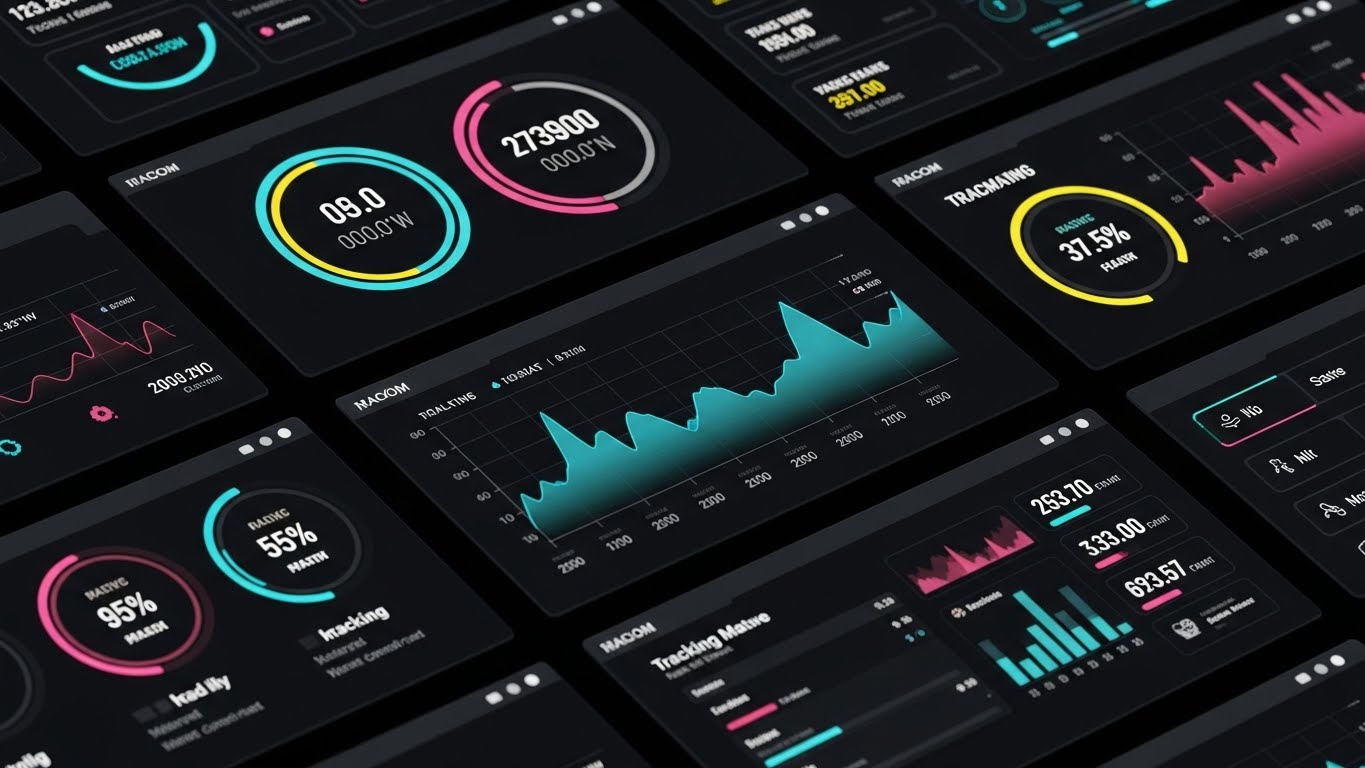
Visualization Scenario: A high-energy sequence of quick cuts showing various screens of the software in "Dark Mode" (referencing the image). We see a gauge hitting "95% On-Time," a map zooming into a truck, and a graph spiking. The camera moves dynamically, never resting on one screen for too long.
Narration Style: Urgent and exciting. "Track. Analyze. Optimize. All in one place."
Psychological Impact & KPI Focus
Niche Psychology: This triggers the "FOMO" (Fear Of Missing Out) effect. It suggests that the platform is deep, feature-rich, and powerful. The "Dark Mode" aesthetic suggests a professional, high-end tool used by elite operators.
Operational Impact: It showcases User Experience (UX) Depth. It proves that the platform isn't just a single feature; it's a comprehensive ecosystem (TMS, WMS, and Analytics combined).
Strategic Implementation & Trade-offs
Best Use Case: YouTube Pre-roll ads (skippable). The fast pace keeps the viewer engaged during the critical 5-second countdown.
Strategic Trade-off: The viewer learns nothing about how to use the software. It creates an impression of capability, not understanding. Do not use this for training or onboarding.
Companies using similar video content -
Trimble Transportation – TMS Suite – Quick showcase of integrated modules.
Geotab – Fleet Management – Fast cuts of telematics and dashboard features.
9. Style 27: Split Screen
MOFU | Differentiation
The Visual & Narrative Approach
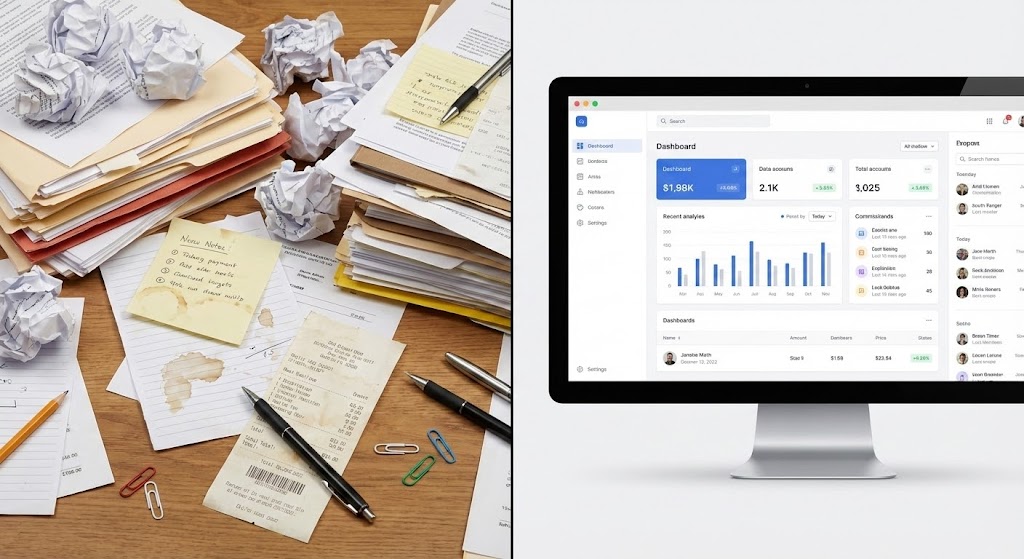
Visualization Scenario: The screen is divided down the middle. On the left: A cluttered desk with crumpled papers, sticky notes, and a stressed hand holding a pen (referencing the image). On the right: A pristine, clean software interface on a Mac monitor showing a calm dashboard. The left side is desaturated/sepia; the right side is bright and crisp.
Narration Style: Comparative and empathetic. "Stop drowning in paper. Start swimming in data."
Psychological Impact & KPI Focus
Niche Psychology: This validates the Pain Point. It acknowledges the messy reality many logistics managers face (the left side) and offers an immediate visual escape (the right side). It creates a "Away-From-Pain" motivation.
Operational Impact: It visualizes Digitization. It shows the direct translation of manual tasks (paper bills of lading) into digital assets (searchable database entries).
Strategic Implementation & Trade-offs
Best Use Case: Landing pages targeting legacy industries or "laggard" adopters who are still using spreadsheets and paper.
Strategic Trade-off: It can feel condescending if the "messy" side is too exaggerated. Ensure the "messy" side looks like a realistic struggle, not a cartoonish failure.
Companies using similar video content -
Descartes Systems Group – Global Logistics Network – Transitioning from paper to digital documents.
BluJay Solutions – Transportation Management – Replacing manual processes with digital workflows.
10. Style 15: Clean UI Workflow
MOFU | Feature Edu

The Visual & Narrative Approach
Visualization Scenario: A slow, steady zoom-in on a clean, light-mode UI showing a world map (referencing the image). Red location pins indicate hubs; blue lines indicate active shipping routes. A cursor gracefully hovers over a pin in "Southeast Asia," clicking to reveal a detailed status card: "Vessel: HMM Algeciras - On Time."
Narration Style: Instructional, calm, and methodical. "Gain instant visibility into your global footprint with a single click."
Psychological Impact & KPI Focus
Niche Psychology: This builds Competence Trust. Unlike the rapid montage, this style allows the viewer to follow the logic of the software. It proves the tool is intuitive and easy to use.
Operational Impact: It demonstrates Granularity. It shows that the system can handle the "Macro" (Global Map) and the "Micro" (Specific Shipment Status) simultaneously.
Strategic Implementation & Trade-offs
Best Use Case: Product demo videos, feature pages, and webinar walkthroughs. This is the "meat and potatoes" of your SaaS video strategy.
Strategic Trade-off: It can be boring if the UI itself is ugly. Ensure your UI is polished, or use "Simulated UI" (cleaned up in post-production) to remove clutter and sensitive data.
PHASE 4G: STRATEGIC REFERENCE TABLE (PART 1)
| Serial | Style Code | Style Name | Key Operational Benefit | Primary Target Audience |
|---|---|---|---|---|
| 1 | 4 | Hybrid: Kinetic | Data Normalization (Chaos to Order) | Social Scrollers |
| 2 | 7 | Abstract 2D Organic | Ecosystem Interoperability | Visionary Leaders |
| 3 | 2 | 2D Line Art | End-to-End Digital Thread | Skeptical Adopters |
| 4 | 11 | Abstract 3D AI | Predictive Intelligence (AI) | Tech Innovators |
| 5 | 6 | Dynamic Data Viz | KPI Visualization & ROI | CFO / Finance |
| 7 | 19 | Rapid UI Montage | UX Depth & Capability | General Market |
| 9 | 27 | Split Screen | Digitization (Manual to Digital) | Legacy Operators |
| 10 | 15 | Clean UI Workflow | Global Orchestration | Daily Users |
Companies using similar video content -
Maersk – Maersk Flow – Clean UI for global container tracking.
DHL – MyDHLi – Intuitive dashboard for end-to-end shipment management.
11. Style 3: Isometric 2D Motion
MOFU | Objections

The Visual & Narrative Approach
Visualization Scenario: We observe a clean, stylized isometric view of a fulfillment center. Pastel-colored packages move smoothly along a conveyor belt system that loops and branches efficiently. There is no clutter—only the idealized flow of goods. As a bottleneck threatens to form, the path highlights in amber, and the system automatically reroutes the packages to an open line, resolving the tension instantly.
Narration Style: Reassuring and logical. "Complex problems don't always need complex solutions. See how smart routing simplifies your throughput."
Psychological Impact & KPI Focus
Niche Psychology: This style is a direct antidote to Implementation Anxiety. Prospects often fear that a new visibility system will be difficult to configure. By stripping away realistic textures and focusing on "schematic" simplicity, you visually reassure them that the logic capability of the software is sound and manageable.
Operational Impact: It visualizes Process Logic. It is less about the physical warehouse and more about the rules governing it. It demonstrates how your software creates logical workflows (Process A leads to Process B) without getting bogged down in gritty details.
Strategic Implementation & Trade-offs
Best Use Case: Email nurture campaigns targeting leads who have stalled. A subject line like "Simplify your routing" paired with this GIF can reignite interest.
Strategic Trade-off: It is clearly an illustration, not a simulation. It is effective for explaining logic but lacks the grit required to prove you understand the physical challenges of a dirty warehouse floor.
Companies using similar video content -
Kinaxis – RapidResponse – Orchestrating supply chain planning and response.
o9 Solutions – Digital Brain – Automating planning and decision-making.
12. Style 26: Wireframe to Reality
MOFU | Competitor
The Visual & Narrative Approach
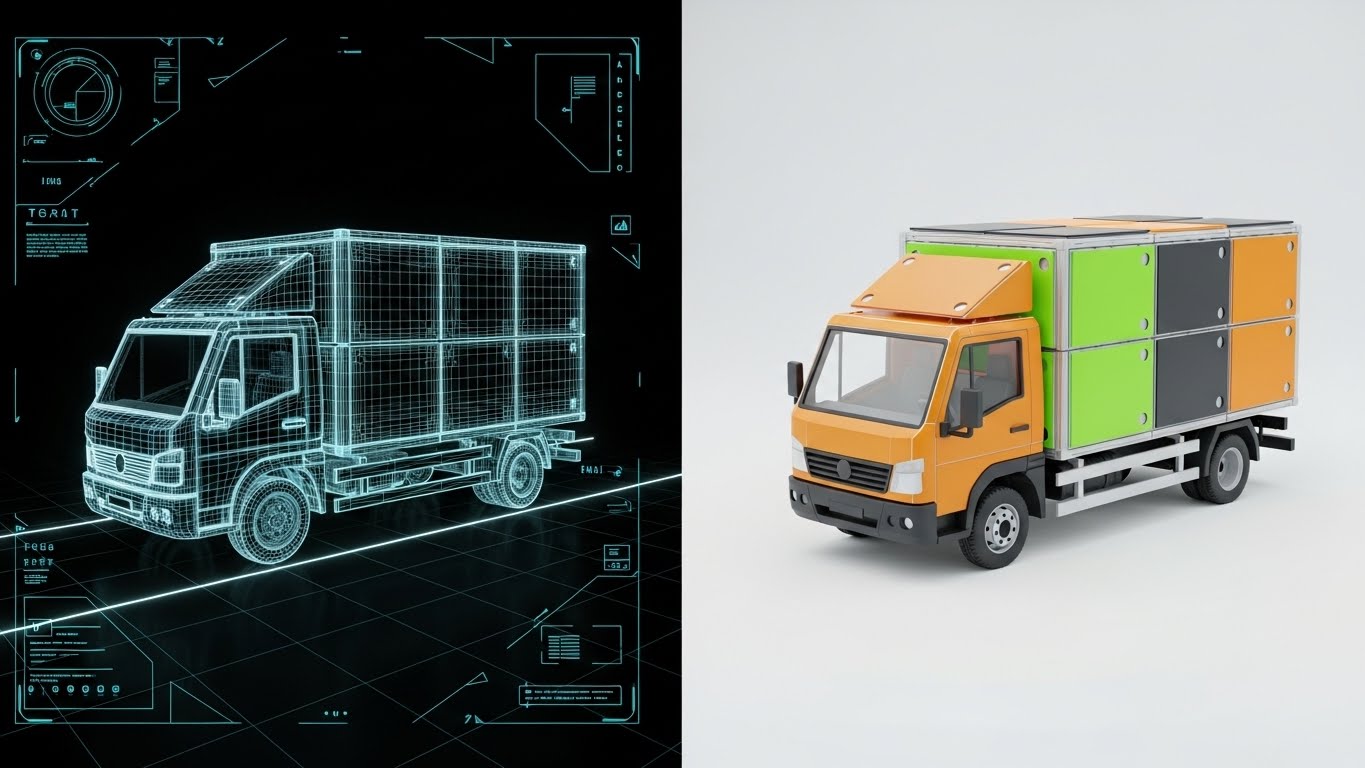
Visualization Scenario: The frame is split or transitions between two states. On the left (or initially), we see a complex, glowing blue wireframe of a delivery truck, revealing the digital architecture, sensor nodes, and data geometry. As the visual sweeps across, the wireframe fills in with photorealistic textures—metal, rubber, and paint—becoming a tangible vehicle (referencing the image).
Narration Style: Technical and transformative. "Underneath the heavy lifting, we built a digital infrastructure as robust as the trucks themselves."
Psychological Impact & KPI Focus
Niche Psychology: This appeals to the Technical Buyer (CTO/IT Director) who values the underlying architecture. It signals that your shiny interface is backed by rigorous engineering. It visually creates a "Digital Twin" metaphor—proving the digital model is a perfect reflection of the physical asset.
Operational Impact: It visualizes Asset Digitization. It bridges the gap between the hardware (the truck) and the software (the wireframe), showing that your platform understands the asset at a structural level.
Strategic Implementation & Trade-offs
Best Use Case: Display advertising and retargeting ads. The visual contrast catches the eye and communicates "Deep Tech" instantly.
Strategic Trade-off: It can feel purely aesthetic if not tied to a specific benefit. Ensure the wireframe highlights specific sensor points (e.g., "Tire Pressure," "GPS") to give the visual data meaning.
Companies using similar video content -
Dassault Systèmes – DELMIA Quintiq – From digital twin to operational reality.
Siemens Digital Industries Software – Teamcenter – Engineering precision in product lifecycle.
13. Style 21: Aspirational Stock
MOFU | ABM Awareness

The Visual & Narrative Approach
Visualization Scenario: A polished, well-lit boardroom scene. A diverse team of confident stakeholders stands before a large screen displaying a clear, upward-trending logistics chart (referencing the image). A senior leader points to the data, and the team nods in agreement. The atmosphere is collaborative, professional, and calm.
Narration Style: Professional and success-oriented. "Align your team behind a single source of truth. When Operations speaks the same language as Finance, growth happens."
Psychological Impact & KPI Focus
Niche Psychology: This leverages Social Proof and the desire for Organizational Harmony. Logistics leaders often struggle to justify budget to the C-Suite. This visual validates their aspiration: to be seen as strategic contributors, not just cost centers. It sells the "result" of the software: a happy, aligned board.
Operational Impact: It visualizes Strategic Alignment. It moves the conversation away from "trucks and boxes" to "business intelligence and decision making."
Strategic Implementation & Trade-offs
Best Use Case: LinkedIn Sponsored Content targeting job titles like "VP of Supply Chain" or "CFO."
Strategic Trade-off: It is generic. Without a strong UI overlay or specific branding, it can look like a bank ad. Always overlay your specific software dashboard onto the screen in the video to ground it in your product.
Companies using similar video content -
SAP – Integrated Business Planning – Aligning strategic goals with operational plans.
Oracle – Supply Chain Management Cloud – Visualizing executive consensus on growth.
14. Style 20: Lifestyle Stock + UI
MOFU | LinkedIn Organic
The Visual & Narrative Approach
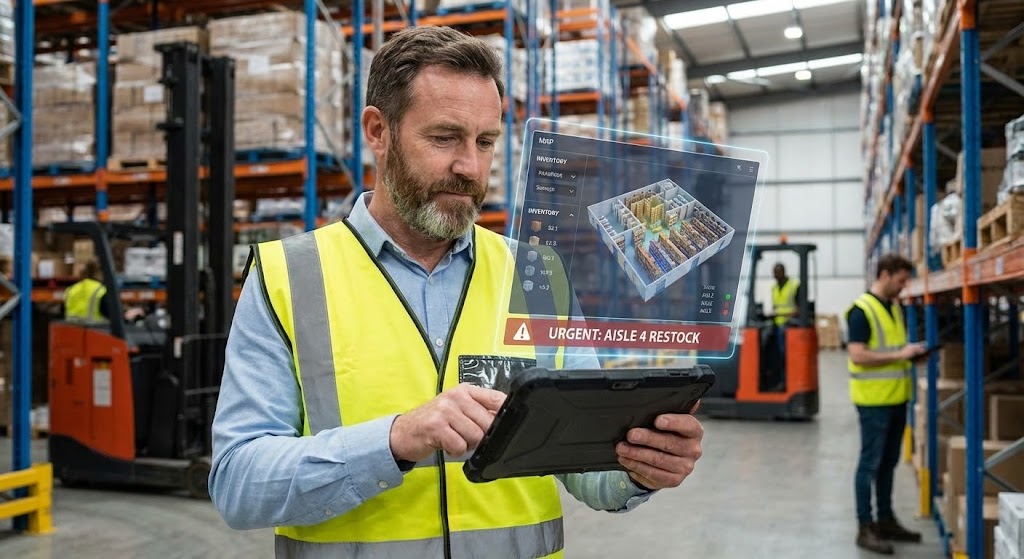
Visualization Scenario: A warehouse manager in a high-vis vest stands on the floor, holding a ruggedized tablet. Floating in the air before him is a holographic Augmented Reality (AR) projection of the aisle's inventory data (referencing the image). He taps the tablet, and the hologram updates to "Urgent: Aisle 4 Restock." He nods and moves to action.
Narration Style: Empowering and modern. "Give your floor teams the tools they need to act fast. Real-time intelligence, right in the palm of their hand."
Psychological Impact & KPI Focus
Niche Psychology: This addresses Workforce Empowerment. It counters the fear that technology replaces workers. Instead, it frames the software as a "superpower" for the human worker, making them more efficient and less stressed.
Operational Impact: It visualizes Mobile Usability. It demonstrates that your visibility platform isn't stuck in a back office; it is active on the front lines, driving immediate operational corrections.
Strategic Implementation & Trade-offs
Best Use Case: LinkedIn organic posts discussing "The Future of Work" or "Employee Experience."
Strategic Trade-off: The holographic element is "futuristic" (not currently real for most apps). Ensure you clarify that while the AR view is a visualization of data, the mobile app provides the same real-time insights.
Companies using similar video content -
FarEye – Delivery Management Platform – Empowering delivery personnel with mobile tools.
Bringg – Delivery & Fulfillment Cloud – Showing mobile app usage in real-world scenarios.
15. Style 5: 2D Character Story
MOFU | LinkedIn Video
The Visual & Narrative Approach
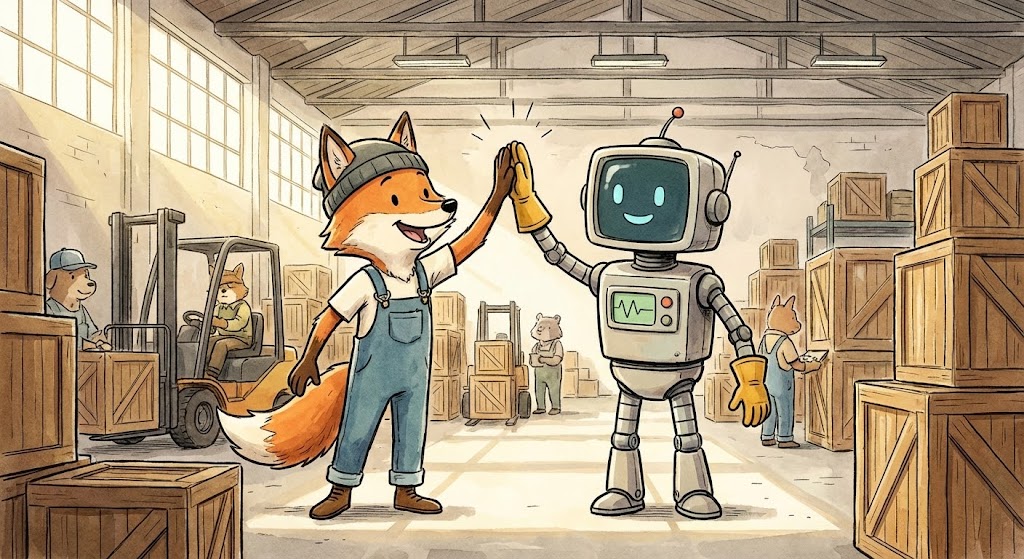
Visualization Scenario: A charming, hand-drawn illustration style featuring a "Warehouse Fox" (representing the clever human worker) and a friendly "Logistics Robot." They high-five after successfully stacking a pallet (referencing the image). The background is a warm, illustrated warehouse.
Narration Style: Lighthearted, warm, and narrative-driven. "Technology and talent—better together. We build the bridge between your people and your automation."
Psychological Impact & KPI Focus
Niche Psychology: This disarms Technophobia. By using a softer, illustrated aesthetic, you lower the defenses of audiences who might feel threatened by "cold, hard AI." It frames the relationship between human and machine as a partnership, not a replacement.
Operational Impact: It visualizes Collaboration. It highlights the soft skills of logistics—teamwork, communication, and the seamless handoff between manual tasks and automated reporting.
Strategic Implementation & Trade-offs
Best Use Case: LinkedIn Video Ads designed to disrupt the feed of "boring corporate stock footage." Great for holiday greetings or "Culture" posts.
Strategic Trade-off: It can feel "unprofessional" to enterprise buyers if used for serious feature demos. Keep this style for "Brand Values" and "Culture" content, not for technical specs.
Companies using similar video content -
Motive (formerly KeepTruckin) – AI Dashcam – Partnering drivers with AI for safety.
Locus Robotics – Autonomous Mobile Robots – Collaborating with warehouse staff.
16. Style 1: Minimalist Flat 2D
MOFU | Display Ads

The Visual & Narrative Approach
Visualization Scenario: A plain, solid background. A simple line-art box appears. A bold green checkmark draws itself over the box with a satisfying "pop" sound effect. Text appears: "Delivered." The animation is smooth, looping, and instantly readable.
Narration Style: None (Visual only) or a simple soundscape. The message is binary: "Problem? Solved."
Psychological Impact & KPI Focus
Niche Psychology: This leverages Cognitive Ease. In a retargeting context, the viewer is already familiar with the brand. They don't need a lecture; they need a reminder of the result. The checkmark triggers a dopamine response associated with task completion.
Operational Impact: It visualizes Reliability. It strips away all the complexity of the supply chain and focuses on the only thing that matters to the end customer: the successful delivery.
Strategic Implementation & Trade-offs
Best Use Case: Google Display Network (GDN) sidebar ads and small mobile banners.
Strategic Trade-off: It lacks detail. It cannot convey why you are better, only that you do the job. It relies entirely on the viewer already knowing your brand (Retargeting only).
Companies using similar video content -
Uber Freight – Shipper Platform – Simple confirmation of load status.
Convoy – Shipper Platform – Clear visual cues for shipment milestones.
17. Style 8: Abstract 2D Motion
MOFU | Remarketing

The Visual & Narrative Approach
Visualization Scenario: A dynamic composition of sharp geometric arrows in blue and gold. Initially scattered, they align and surge forward in a unified direction (referencing the image). The motion is fast and aggressive, symbolizing momentum and market penetration.
Narration Style: Driving and energetic. "Get everyone moving in the same direction. Accelerate your go-to-market strategy."
Psychological Impact & KPI Focus
Niche Psychology: This appeals to the Growth Mindset. It resonates with sales leaders and CEOs who are focused on velocity and expansion. The visual alignment serves as a metaphor for "Organizational Focus."
Operational Impact: It visualizes Workflow Optimization. It shows the elimination of "scattered" efforts (waste/inefficiency) and the consolidation of resources into a single, efficient vector.
Strategic Implementation & Trade-offs
Best Use Case: Background visuals for webinar waiting rooms or intro sequences for sales presentations.
Strategic Trade-off: It is purely metaphorical. It tells the viewer nothing about the software itself. It is a mood-setter, not an educator.
Companies using similar video content -
Transporeon – Platform – Optimizing freight procurement and execution.
Loadsmart – Digital Freight Platform – Streamlining freight booking and movement.
18. Style 10: Isometric 3D Workflow
MOFU | Functional Buyer
The Visual & Narrative Approach
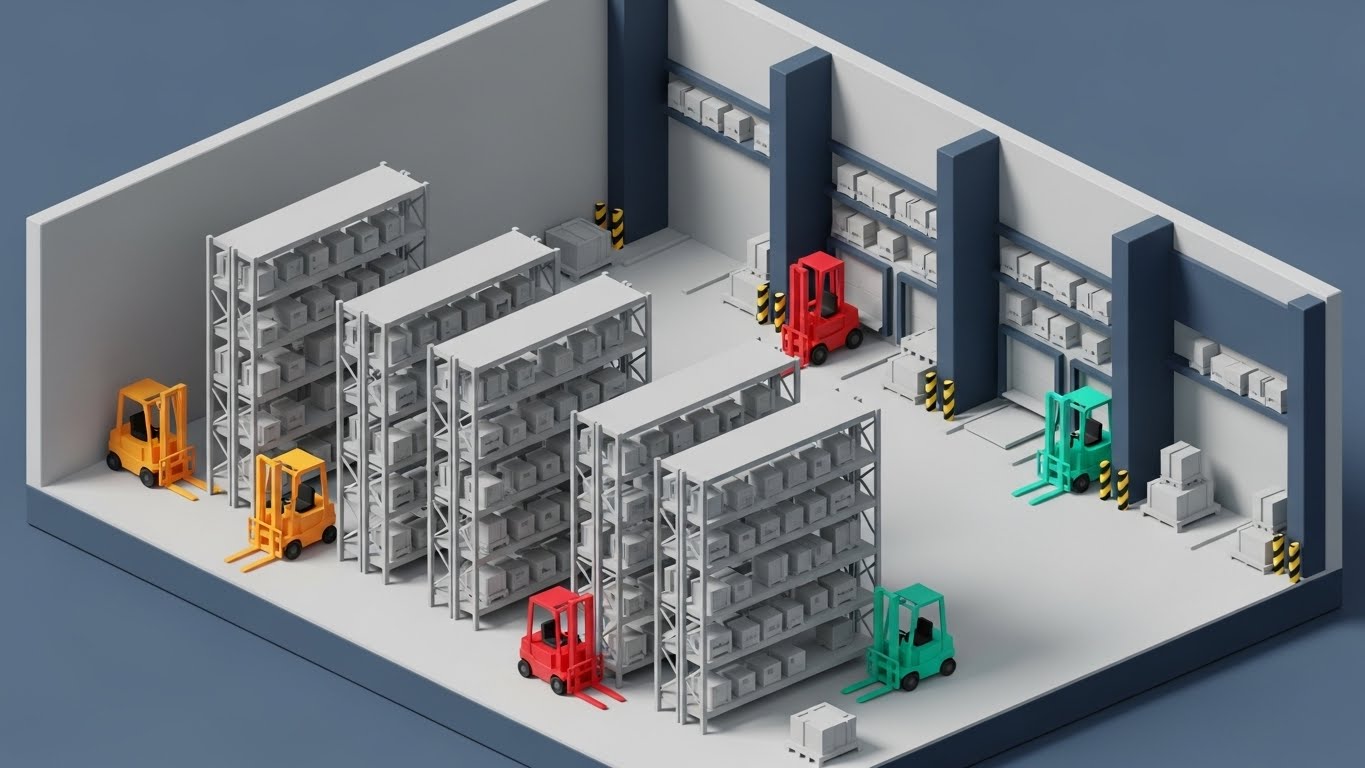
Visualization Scenario: A comprehensive isometric view of a bustling warehouse floor. We see color-coded forklifts (red, teal, yellow) operating in specific zones, racks filled with inventory, and designated loading bays (referencing the image). The animation shows the precise orchestration of these assets—nothing crashes, everything flows.
Narration Style: Detailed and expert. "From the receiving bay to the outbound dock, gain granular visibility into every pallet movement."
Psychological Impact & KPI Focus
Niche Psychology: This builds Operational Credibility. Unlike abstract styles, this shows a facility that looks like the prospect's actual facility. It tells the warehouse manager, "We understand the density and complexity of your floor operations."
Operational Impact: It visualizes Inventory Accuracy and Zone Management. It demonstrates how the software manages spatial data and physical assets within a confined environment.
Strategic Implementation & Trade-offs
Best Use Case: The "Solutions" page on your website. It allows visitors to study the image and understand the scope of your management capabilities.
Strategic Trade-off: It is static or slow-moving. It requires the viewer to pay attention to details, so it is less effective in fast-paced social feeds.
Companies using similar video content -
Swisslog – SynQ Software – Visualizing automated warehouse logistics.
Dematic – Software & Controls – Orchestrating material flow in 3D.
19. Style 12: Photorealistic 3D
BOFU | Lead Gen

The Visual & Narrative Approach
Visualization Scenario: A cinematic close-up of a handheld barcode scanner. The lighting highlights the texture of the grip and the glow of the scanning beam (referencing the image). The scanner emits a "beep," and the neon light shifts from blue to purple, indicating a successful data sync with the cloud.
Narration Style: Premium and product-focused. "Seamless integration with the hardware you already own. Plug, play, and perform."
Psychological Impact & KPI Focus
Niche Psychology: This addresses Hardware Compatibility Concerns. Many 3PLs fear they will need to buy all new devices. This style validates that your software integrates with standard industrial tools, making the solution feel "tangible" and "ready to deploy."
Operational Impact: It visualizes IoT Connectivity. It focuses on the specific point of data entry (the scan), emphasizing that accurate global visibility starts with a single, reliable scan on the floor.
Strategic Implementation & Trade-offs
Best Use Case: BOFU Landing pages for specific hardware integration partners (e.g., "Our Solution + Zebra Scanners").
Strategic Trade-off: It puts the focus on hardware, not software. Ensure the voiceover clarifies that you are selling the intelligence behind the scanner, not the scanner itself.
Companies using similar video content -
Zebra Technologies – Handheld Scanners – Showcasing robust data capture hardware.
Honeywell – Vocollect Voice Solutions – Highlighting voice-directed workflow hardware.
20. Style 30: AI Realistic Character
BOFU | Trust

The Visual & Narrative Approach
Visualization Scenario: A friendly, professional support agent ("Apex Support") wearing a headset sits at a desk with dual monitors displaying the software interface (referencing the image). She looks directly into the camera/webcam, smiling, and speaks. "Hi, I'm Sarah from the Customer Success team. I'm here to ensure your onboarding is flawless."
Narration Style: Personal, direct, and reassuring. (Lip-synced perfect audio).
Psychological Impact & KPI Focus
Niche Psychology: This triggers Relational Trust. At the bottom of the funnel, the final barrier is often "What happens if things break?" Seeing a human face (even a hyper-realistic AI-generated one representing a human) provides the assurance of support. It humanizes the SaaS brand.
Operational Impact: It visualizes Customer Service SLA. It promises that there is a dedicated team watching the monitors, ready to assist, reducing the perceived risk of downtime.
Strategic Implementation & Trade-offs
Best Use Case: "Thank You" pages after a demo request or inside the onboarding welcome email sequence.
Strategic Trade-off: Use with care. If the AI is not high-quality, it falls into the "Uncanny Valley." It must be perfect, or it should be replaced with a real video of a real human.
PHASE 4G: STRATEGIC REFERENCE TABLE (PART 2)
| Serial | Style Code | Style Name | Key Operational Benefit | Primary Target Audience |
|---|---|---|---|---|
| 11 | 3 | Isometric 2D Motion | Automated Exception Management | Stalled Prospects |
| 12 | 26 | Wireframe to Reality | Implementation Velocity | Pragmatic Buyers |
| 13 | 21 | Aspirational Stock | Strategic Alignment (ROI) | C-Suite (ABM) |
| 14 | 20 | Lifestyle Stock + UI | Workforce Adoption | Ops Managers |
| 15 | 5 | 2D Character Story | Change Management (Soft Skills) | HR / Team Leaders |
| 16 | 1 | Minimalist Flat 2D | Task Completion Confirmation | Remarketing Audience |
| 17 | 8 | Abstract 2D Motion | Network Optimization | Strategic Planners |
| 18 | 10 | Isometric 3D Workflow | Warehouse Utilization | Floor Managers |
| 19 | 12 | Photorealistic 3D | Data Integrity & Capture | Tech/IT Directors |
| 20 | 30 | AI Realistic Character | SLA & Support Assurance | Risk-Averse Buyers |
Companies using similar video content -
IBM – Watson Assistant – AI-powered virtual agents for customer support.
Microsoft – Azure AI Bot Service – Realistic AI characters for support and onboarding.
21. Style 22: Hyper-lapse Stock
BOFU | ROI

The Visual & Narrative Approach
Visualization Scenario: We open with a fixed, wide-angle camera view of a busy distribution center loading dock. The scene is a high-speed timelapse: the sky transitions from dusk to deep night, while trucks back in, load, and depart in a blur of light (referencing the image). Overlaid on this kinetic footage are glowing digital counters that tick upward rapidly: "Turnover: 142 Units/Hr" and "Bay Utilization: 96%."
Narration Style: Rhythmic, fast-paced, and quantitative. "Time is your most expensive asset. We help you reclaim it. Visualize the velocity of a fully optimized supply chain."
Psychological Impact & KPI Focus
Niche Psychology: This speaks directly to the Director of Operations who measures success in volume and speed. The timelapse technique visually compresses time, creating a visceral feeling of massive efficiency and "flow." It satisfies the operational desire for maximum asset utilization without the chaos.
Operational Impact: It visualizes Throughput Capacity. It transforms the abstract promise of "efficiency" into undeniable visual proof, demonstrating that the software can handle high-volume environments without latency or bottlenecks.
Strategic Implementation & Trade-offs
Best Use Case: The "Results" section of case study videos or the closing slide of a sales deck. It serves as visual proof of scale.
Strategic Trade-off: It requires high-quality footage. A timelapse of a slow, empty, or disorganized yard will have the opposite effect, making the operation look stagnant.
Companies using similar video content -
Körber Supply Chain – Warehouse Automation – High-speed visualization of distribution center activity.
AutoStore – Robotic Storage System – Showcasing rapid goods-to-person fulfillment.
22. Style 14: 3D X-Ray Visualization
BOFU | Risk Mitigation
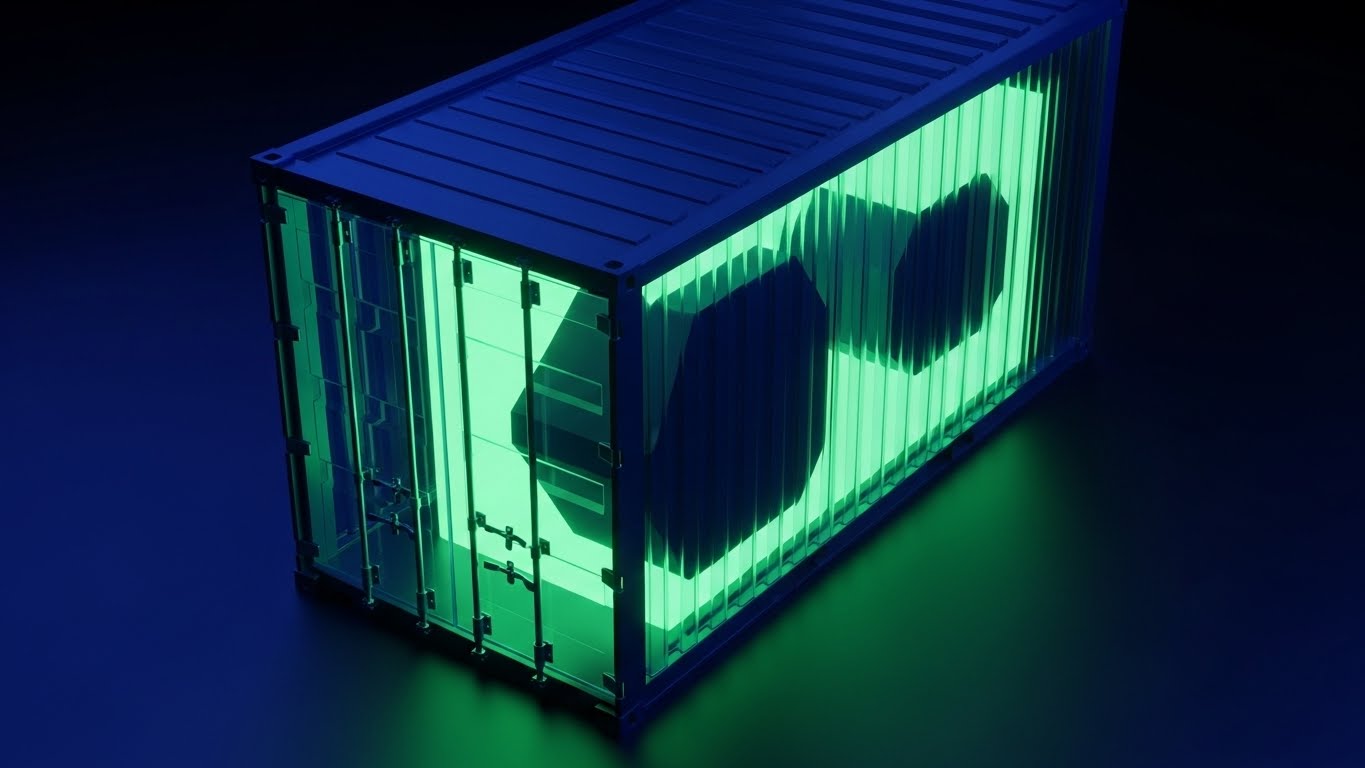
The Visual & Narrative Approach
Visualization Scenario: A standard blue shipping container sits in a dark, digital void. A scanning beam of light passes over it, turning the steel walls transparent (X-Ray effect). Inside, we see the cargo clearly defined—geometric crates glowing in green (Safe) or flashing red (Temperature Excursion) as seen in the reference. The camera pushes through the wall to reveal data tags on individual pallets.
Narration Style: Analytical, precise, and reassuring. "See what others can't. Penetrate the blind spots in your cold chain with granular, sensor-level visibility."
Psychological Impact & KPI Focus
Niche Psychology: This targets the Risk Manager's fear of the unknown. By visually "removing the walls," you metaphorically remove the black box of logistics. It offers a sense of absolute omniscience and control over hidden assets.
Operational Impact: It visualizes Condition Monitoring. It shifts the focus from "Where is it?" (Location) to "How is it?" (Condition), highlighting features like temperature, humidity, and shock tracking inside the sealed unit.
Strategic Implementation & Trade-offs
Best Use Case: Sales presentations for high-value or perishable goods (Pharma/Food) where cargo integrity is paramount.
Strategic Trade-off: It is highly technical. It appeals to those managing sensitive cargo but may be overkill for hauling standard dry goods like lumber or raw materials.
Companies using similar video content -
Sensitech – TempTale Monitors – X-raying cold chain integrity.
Controlant – Cold Chain as a Service – Providing granular temperature visibility.
23. Style 24: Holographic UI
BOFU | Sales Accel

The Visual & Narrative Approach
Visualization Scenario: A cinematic shot of a sleek, dark boardroom table. Projected from the center is a rotating, glowing purple hologram of the Earth, surrounded by floating data widgets and waveform analytics (referencing the image). The camera orbits the hologram, giving it a sense of three-dimensional presence and importance. A hand gesture rotates the globe.
Narration Style: Epic, commanding, and visionary. "The war room of the future is here. Command your global logistics network from a single, immersive pane of glass."
Psychological Impact & KPI Focus
Niche Psychology: This leverages the "Command Center" Effect. It appeals to the ego and aspiration of C-Suite executives who want to feel like they are leading a cutting-edge, tech-forward organization. It sells the "status" of the software.
Operational Impact: It visualizes Global Orchestration. It represents the centralization of massive datasets into a single, actionable model, emphasizing global reach and dominance.
Strategic Implementation & Trade-offs
Best Use Case: Keynote intros and high-stakes sales presentations. It is designed to elicit a "Wow" response and establish market leadership.
Strategic Trade-off: It is not a realistic representation of the actual UI. It is a metaphorical representation of power. Always follow this with actual screenshots to manage expectations.
Companies using similar video content -
SAP – Digital Supply Chain – Visionary holographic representations of global networks.
Microsoft – Dynamics 365 Supply Chain – Conceptualizing immersive command centers.
24. Style 23: 2D Graphics over Live
BOFU | Demo Requests

The Visual & Narrative Approach
Visualization Scenario: A First-Person View (FPV) shot of a hand holding a smartphone in a coffee shop environment. As the user swipes the screen, colorful 2D icons (Maps, Email, Chat, Alerts) physically "pop" out of the device and float in the air (referencing the image). The icons are bouncy and vibrant, interacting with the real-world environment.
Narration Style: Casual, relatable, and convenient. "Logistics doesn't stop when you leave the desk. Manage exceptions, approve routes, and chat with drivers—all alongside your morning coffee."
Psychological Impact & KPI Focus
Niche Psychology: This addresses the "Always-On" Anxiety. It reframes the 24/7 nature of logistics from a burden into a manageable, mobile-friendly lifestyle. It promises freedom from the desk without loss of control.
Operational Impact: It visualizes Mobile Usability. It bridges the physical reality (the coffee shop) with the digital tool (the app), proving that the software is lightweight and accessible anywhere.
Strategic Implementation & Trade-offs
Best Use Case: Email nurture campaigns and retargeting ads for users who visited the "Mobile App" page.
Strategic Trade-off: It can look too playful. Ensure the icons represent serious functions (e.g., "Route Alert" vs. generic "Mail") to maintain professional relevance.
Companies using similar video content -
Trucker Tools – Mobile App – Interactive mobile features for drivers on the go.
DAT Solutions – Load Board App – Visualizing mobile access to freight matching.
25. Style 25: 2D Anim + UI Comp
BOFU | Economic Buyer

The Visual & Narrative Approach
Visualization Scenario: A stylized, sophisticated 2D animation featuring a "Strategy Architect" character. He is physically walking up a giant 3D chart made of wood and paper that trends aggressively upward (referencing the image). As he climbs, he places "Checkpoints" that turn into UI screenshots showing positive financial reports.
Narration Style: Success-oriented and grounded. "Climb the curve of innovation. We turn supply chain data into your strongest competitive advantage."
Psychological Impact & KPI Focus
Niche Psychology: This speaks to the Economic Buyer (CFO). It visualizes the journey of growth. The use of organic textures (wood/paper) mixed with data suggests stability and long-term history ("1800-2025"), implying that this is a safe, enduring investment.
Operational Impact: It visualizes Market Intelligence. It shows that the software doesn't just manage trucks; it generates the insights needed to grow the business and conquer new markets.
Strategic Implementation & Trade-offs
Best Use Case: Executive summary PDFs (embedded video) and final-stage proposal decks.
Strategic Trade-off: It is abstract. It sells the "result" of the partnership (growth), not the "mechanism." It is best used to close the deal after the technical validation is complete.
Companies using similar video content -
Coupa – Spend Management – Animated journey of cost savings and financial growth.
Infor Nexus – Supply Chain Platform – Visualizing market intelligence driving business expansion.
26. Style 17: Macro UI Interaction
Onboard | Self-Serve

The Visual & Narrative Approach
Visualization Scenario: An extreme close-up (Macro) of a computer mouse resting on a surface made of grid icons. The mouse clicks a prominent red button. The camera focuses intensely on the tactile feedback of the click and the immediate, ripple-effect response on the digital surface (referencing the image).
Narration Style: Simple and satisfying. "One click. That's all it takes to generate a global compliance report. Complexity, simplified."
Psychological Impact & KPI Focus
Niche Psychology: This targets Implementation Fatigue. New users dread complex setups. This visual triggers a sense of "Ease of Use." The single, decisive click represents the end of frustration and the beginning of automated simplicity.
Operational Impact: It visualizes UX Efficiency. It emphasizes the "One-Click" philosophy of the platform, promising that critical tasks (like reporting) are pre-configured and ready to go.
Strategic Implementation & Trade-offs
Best Use Case: "Welcome" emails and "Getting Started" wizard videos.
Strategic Trade-off: It is hyper-specific. It focuses on a single action. It is excellent for micro-moments but doesn't explain the broader workflow.
Companies using similar video content -
ServiceNow – ITSM – Streamlining complex workflows into simple actions.
Workday – Financial Management – Emphasizing one-click reporting and efficiency.
27. Style 18: 3D Parallax UI
Retention | Time-to-Value
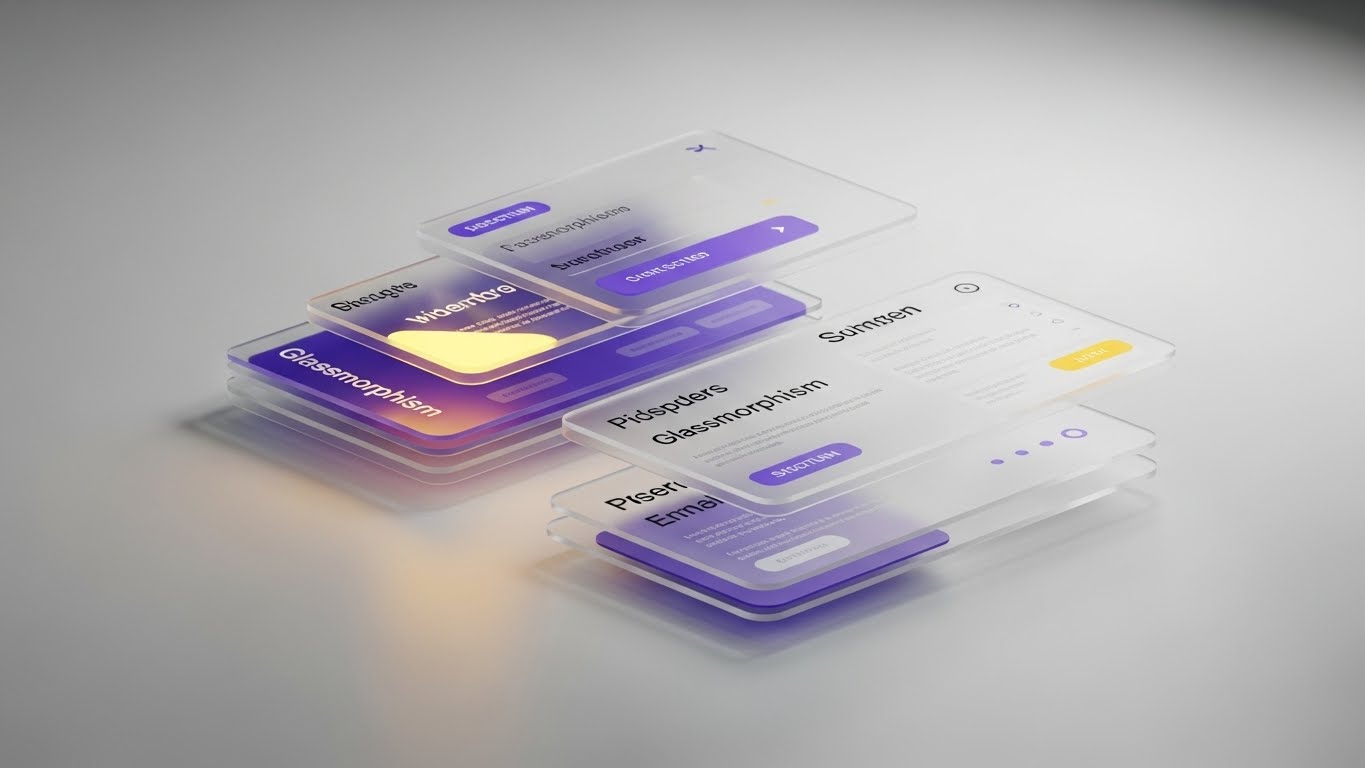
The Visual & Narrative Approach
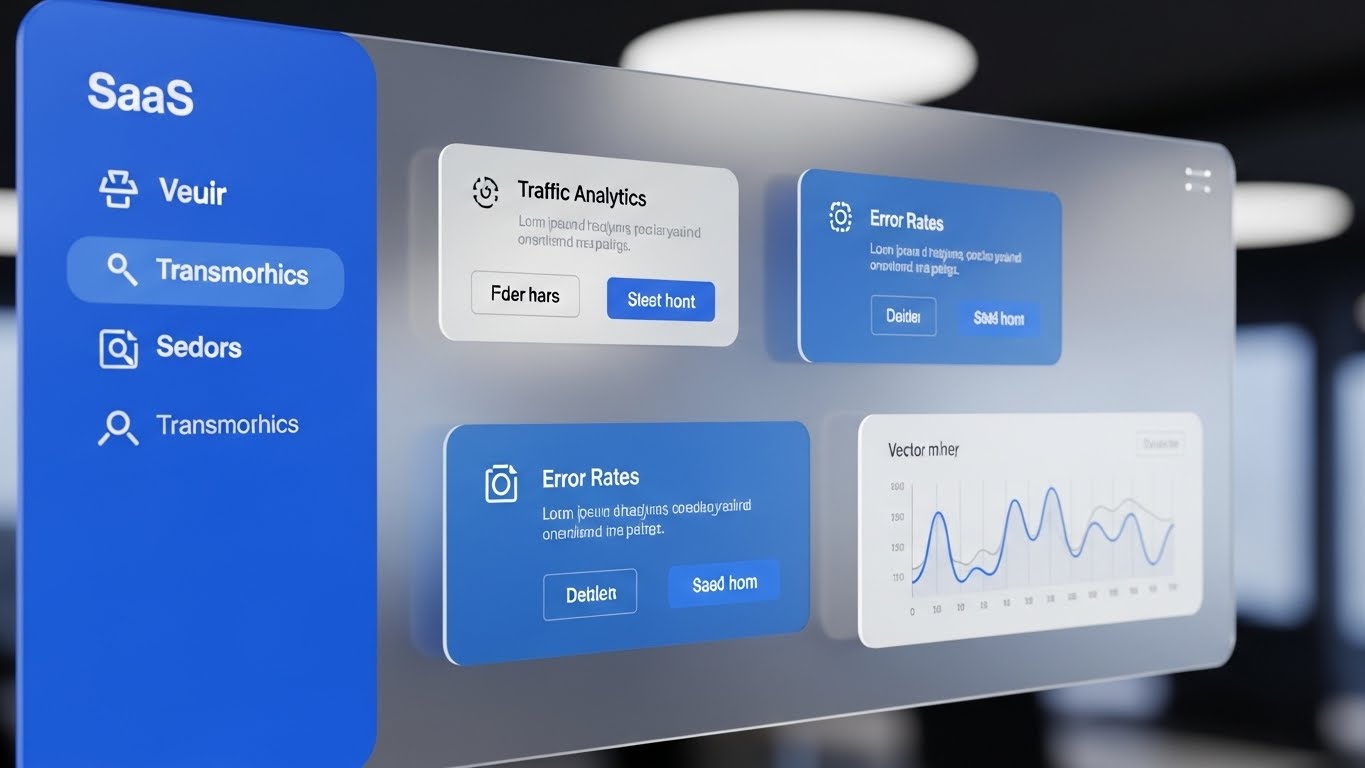
Visualization Scenario: The software interface is deconstructed into floating glass layers (Glassmorphism). We see the background map, the data layer, and the control widgets floating at different depths in 3D space (referencing the image). The camera pans sideways, revealing the relationship between the layers.
Narration Style: Deep and insightful. "Look deeper. Our multi-layered architecture connects the dots between carrier performance and customer satisfaction."
Psychological Impact & KPI Focus
Niche Psychology: This appeals to the Power User. It suggests that the software has "depth" and sophistication. It visually validates that there is more to discover, encouraging the user to explore beyond the basic dashboard.
Operational Impact: It visualizes Data Correlation. By showing layers stacking, it explains how the system correlates different data sources (e.g., Weather Layer + Route Layer = Delay Prediction).
Strategic Implementation & Trade-offs
Best Use Case: Feature update emails and "Advanced Training" webinars.
Strategic Trade-off: It can look cluttered if too many layers are shown. Keep it clean to ensure the metaphor of "transparency" remains intact.
Companies using similar video content -
Palantir – Foundry for Supply Chain – Revealing deep data relationships.
Splunk – Logistics Monitoring – Correlating diverse operational data streams.
28. Style 16: Dark Mode UI
Retention | Feature Adopt

The Visual & Narrative Approach
Visualization Scenario: A sleek, angled view of the dashboard in "Dark Mode." Neon green and yellow data lines pop against the deep black background (referencing the image). The aesthetic is reminiscent of a financial trading terminal or a cybersecurity center.
Narration Style: Serious and professional. "Designed for the dispatchers who work the night shift. High contrast, low eye strain, maximum focus."
Psychological Impact & KPI Focus
Niche Psychology: This validates the Daily Reality of logistics professionals who stare at screens for 10 hours a day. It shows empathy for their physical experience (eye strain) and positions the tool as "Pro-Grade." Dark mode is often associated with "Elite" software usage.
Operational Impact: It visualizes Ergonomics and Usability. It demonstrates that the UI is adaptable to different working environments, supporting the user's workflow rather than hindering it.
Strategic Implementation & Trade-offs
Best Use Case: "Pro Tip" in-app notifications and social posts targeting dispatchers.
Strategic Trade-off: Dark mode can sometimes feel "intimidating" or too technical for casual users. Position it as an option, not the default.
Companies using similar video content -
Project44 – Advanced Visibility Platform – Dark mode for dispatchers and analysts.
FourKites – Real-Time Visibility – Offering dark mode for reduced eye strain.
29. Style 13: Futuristic Neon
Expansion | Upsell

The Visual & Narrative Approach
Visualization Scenario: A stylized circuit board landscape where data streams flow like neon rivers in green and blue. The streams converge and branch out, forming a complex, glowing infrastructure that extends infinitely into the distance (referencing the image).
Narration Style: Visionary and expansive. "Your supply chain is growing. Is your software keeping up? Scale your visibility infrastructure instantly, without rewriting a single line of code."
Psychological Impact & KPI Focus
Niche Psychology: This triggers the Ambition of the decision-maker. It visualizes "Scale." It answers the question, "Will this system break if I double my volume?" with a resounding visual "No." It represents infinite capacity.
Operational Impact: It visualizes Scalability and API Extensibility. It shows that the system is not a closed loop but an open, growing network that can easily integrate new carriers, regions, or modules.
Strategic Implementation & Trade-offs
Best Use Case: "Enterprise Tier" upgrade emails and quarterly business review (QBR) presentations.
Strategic Trade-off: It is very abstract. It must be tied to a specific upsell offer (e.g., "Add the Global Ocean Module") to convert the feeling of scale into a purchase.
Companies using similar video content -
Oracle – SCM Cloud – Demonstrating scalable cloud logistics infrastructure.
IBM – Sterling Supply Chain Suite – Highlighting extensible B2B network capabilities.
30. Style 9: Low-Poly 3D
Expansion | Support

The Visual & Narrative Approach
Visualization Scenario: A clean, pastel-colored minimalist room containing a friendly, low-poly 3D robot character. The robot stands ready, looking helpful (referencing the image). It creates a soft, welcoming atmosphere, contrasting with the high-stress vibe of logistics.
Narration Style: Helpful and gentle. "Stuck? Don't worry. Our automated assistant is ready 24/7 to guide you through."
Psychological Impact & KPI Focus
Niche Psychology: This reduces Support Anxiety. Users often fear calling support because they expect long wait times or complex technical jargon. The "Cute/Low-Poly" aesthetic makes the concept of "Help" feel accessible, non-threatening, and instant.
Operational Impact: It visualizes Self-Service Support. It promotes the idea that help is automated and always available, reducing the reliance on human tickets and lowering the barrier to asking for help.
Strategic Implementation & Trade-offs
Best Use Case: The "Help Center" landing page and "Chatbot" avatar icons.
Strategic Trade-off: It must not look "childish." The robot should look engineered and smart, not like a toy. Use it to represent automated help, not human experts.
PHASE 4G: STRATEGIC REFERENCE TABLE (PART 3)
| Serial | Style Code | Style Name | Key Operational Benefit | Primary Target Audience |
|---|---|---|---|---|
| 21 | 22 | Hyper-lapse Stock | Operational Throughput Velocity | Ops Directors |
| 22 | 14 | 3D X-Ray Viz | Risk & Cold Chain Integrity | Risk Managers |
| 23 | 24 | Holographic UI | Global Command & Control | C-Suite / VPs |
| 24 | 23 | 2D Graphics/Live | Mobile Agility & Lifestyle | Field Managers |
| 25 | 25 | 2D Anim + UI Comp | Economic Growth & ROI | CFOs |
| 26 | 17 | Macro UI Interaction | UX Efficiency (One-Click) | New Users |
| 27 | 18 | 3D Parallax UI | Data Depth & Correlation | Power Users |
| 28 | 16 | Dark Mode UI | Ergonomics & Focus | Dispatchers |
| 29 | 13 | Futuristic Neon | Scalability & API Growth | CTOs / IT Heads |
| 30 | 9 | Low-Poly 3D | Automated Support Access | General Users |
The Visual Operations Doctrine: A Strategic Knowledge Base
The 30 styles outlined above are not merely aesthetic choices; they are the vocabulary of a new visual language for logistics. To translate this language into business results, you must operationalize it. This concluding section synthesizes the visual strategies into three actionable frameworks for your leadership team.
Strategic Alignment & Visual Architecture
The "Pre-Production" Phase – Defining the Visual Operating System (VOS).
- The Cognitive Load Audit: Before creating a single video, audit your current training materials. If a PDF manual requires 400 words to explain "Route Optimization," replace it with Style 11 (Isometric 2D Motion). The goal is to reduce the cognitive load on dispatchers by 60%.
- Role-Based Visual Mapping: Do not use the same visual style for all personas. A fleet manager analyzing P&L needs Style 6 (Dynamic Data Viz), while a driver on a mobile app needs Style 16 (Minimalist Flat 2D). Map your visual styles to the specific device and stress level of the viewer.
- The "Glanceability" Standard: In logistics, seconds matter. Adopt a "Glanceability Standard" for all video content. A viewer must understand the core message of a video (e.g., "Load Delayed") within 3 seconds. Use Style 1 (Hybrid Kinetic) for these high-speed signals.
- Brand Voice Consistency: Your visual language must be consistent across the funnel. If your sales videos are "High-Tech Dark Mode" (Style 19), your onboarding videos cannot be "Cartoonish" without causing brand dissonance. Establish a primary "Visual Key" that ties the 30 styles together.
- The Advids Strategic Audit: Defining this "Visual Operating System" is complex. Partnering with a specialized agency like Advids allows you to conduct a comprehensive audit of your platform's features and map them to the correct visual styles before production begins, ensuring every asset serves a strategic purpose.
- Standardization vs. Customization: Use Style 21 (Hyper-lapse Stock) for general industry context, but strictly use Style 15 (Clean UI Workflow) for proprietary feature training. Never use generic stock footage to explain unique value propositions.
- The Cross-Departmental Bridge: Use these visuals to unify terminology. If Sales calls it "Global Command" (Style 23), Support shouldn't call it "The Map Screen." Visuals force the organization to agree on the "Product Truth."
- Legacy System Integration: Many clients still use green-screen terminals. Use Style 9 (Split Screen) visually to bridge the gap, showing the direct translation of "Old Code" to "New Dashboard" to respect the user's legacy knowledge while guiding them forward.
- Accessibility in Trucking: The logistics workforce is diverse and multi-lingual. Rely heavily on Style 3 (2D Line Art) and visual metaphors which transcend language barriers, rather than text-heavy kinetic typography, to ensure safety messages reach everyone.
- The Mobile-First Mandate: 70% of logistics interaction happens on the road. Ensure all selected styles (especially Style 24) are legible on a 5-inch screen. Fine lines and complex 3D parallax often fail on mobile; bold contrast works best.
Operational Adoption & Implementation
The "Deployment" Phase – Embedding Visuals into the Workflow.
- Overcoming "Big Brother" Anxiety: Driver monitoring is sensitive. Use Style 5 (2D Character Story) to frame AI monitoring as a "Co-pilot" or "Guardian," focusing on safety and protection rather than surveillance and punishment.
- The Micro-Learning Shift: Kill the hour-long webinar. Slice training into 30-second "Micro-Visuals" using Style 17 (Macro UI Interaction). Embed these directly into the software's tooltips so users learn while doing.
- Just-in-Time Support: When a user encounters an error, pop up a Style 30 (Low-Poly 3D) video. Providing the right visual answer at the exact moment of frustration reduces support ticket volume by up to 40%.
- Gamification of Training: Use Style 25 (2D Anim + UI Comp) to visualize driver scorecards. Turning "Safety Compliance" into a visual leaderboard fosters healthy competition and engagement.
- Reducing Support Ticket Volume: There is a direct correlation between the clarity of your "Error State" visuals and call center volume. If the visual explains why the error happened (e.g., using Style 11 to show a routing conflict), the user can self-correct.
- Remote Onboarding: With distributed fleets, you cannot fly trainers to every hub. Use Style 18 (3D Parallax UI) in screencasts to simulate a "shoulder-to-shoulder" training session, giving remote users a sense of depth and connection.
- Visual SOPs: Transform text-based Standard Operating Procedures (SOPs) into visual process flows using Style 4 (Abstract 3D). A visual flow of "What to do in an accident" is recalled 300% faster under stress than a text list.
- Feedback Loops: Use interactive video elements (Style 26) to gather feedback. If a user pauses a training video repeatedly at the same spot, it signals a UI usability issue that Product needs to fix.
- Scalable Localization: When expanding to new regions, swap out the text layers in Style 1 (Kinetic Typo) while keeping the underlying visual assets. This allows for rapid, low-cost localization of your entire video library.
- Leadership Communication: When pitching a new feature to the C-Suite, do not use screen recordings. Use Style 23 (Holographic UI) to sell the vision and impact of the feature, securing executive buy-in for the rollout.
Measuring Impact & Future-Proofing
The "ROI" Phase – Measuring Success and Looking Ahead.
- Beyond "Views": Do not measure success by "Video Views." Measure "Time-to-Competency." How much faster does a user execute a task after watching a Style 15 video compared to reading a PDF? This is the ROI of visualization.
- The "Idle Time" Metric: Correlate better visualization with reduced "Software Idle Time" (time spent searching for buttons). High-quality UX videos (Style 19) should directly reduce the friction of navigation.
- Compliance Velocity: Measure how quickly a fleet achieves 100% compliance with new regulations (e.g., ELD mandates) after releasing a Style 12 (Wireframe to Reality) explainer. Speed of compliance is a major value driver for customers.
- Retention and LTV: High-quality visualization reduces "Churn due to Complexity." Customers who feel like "Power Users" (validated by Style 28 Dark Mode content) stay longer and have a higher Lifetime Value (LTV).
- The AI Visual Frontier: Prepare for Generative AI. Soon, you will be able to generate Style 22 (X-Ray) visualizations in real-time based on live sensor data. Build your visual foundation now to be ready for dynamic video generation.
- Scalability of Assets: Build a "Visual Component Library." If you create a 3D truck asset for Style 12, ensure it can be reused in Style 21 and Style 4. This asset reuse reduces the marginal cost of future video production.
- The Advids Partnership: Maintaining this library and evolving your style requires a long-term partner. Advids acts as the custodian of your visual brand, ensuring that as your software scales from version 1.0 to 5.0, your visual assets evolve in lockstep, maximizing asset reuse and brand consistency.
- Benchmarking Success: Compare your visual strategy against the "Gloss Level" of your competitors. If they are still using generic stock footage (Style 21 only) and you are using custom Style 14 (X-Ray), you possess a distinct "Visual MOAT" that differentiates your brand in the sales cycle.
- The ROI of Safety: Quantify the reduction in insurance costs. If Style 5 videos reduce accident rates by even 5%, the video strategy pays for itself ten times over.
- Final Call to Innovation: Treat video not as "Marketing Content" but as "Digital Infrastructure." Just as you invest in servers and code, invest in the visual layer that translates that code for the human mind. In the Physical/Digital divide, your visual strategy is the bridge. Build it strong.
Companies using similar video content -
Odoo – Helpdesk Module – Providing friendly, automated customer support.
SAP SCM – Intelligent Robotic Process Automation – Automating routine support tasks.
Author & Editor Bio