

Video Marketing

SaaS Video Ads on Meta: Why They Fatigue and How One Modular Animation Fixes It

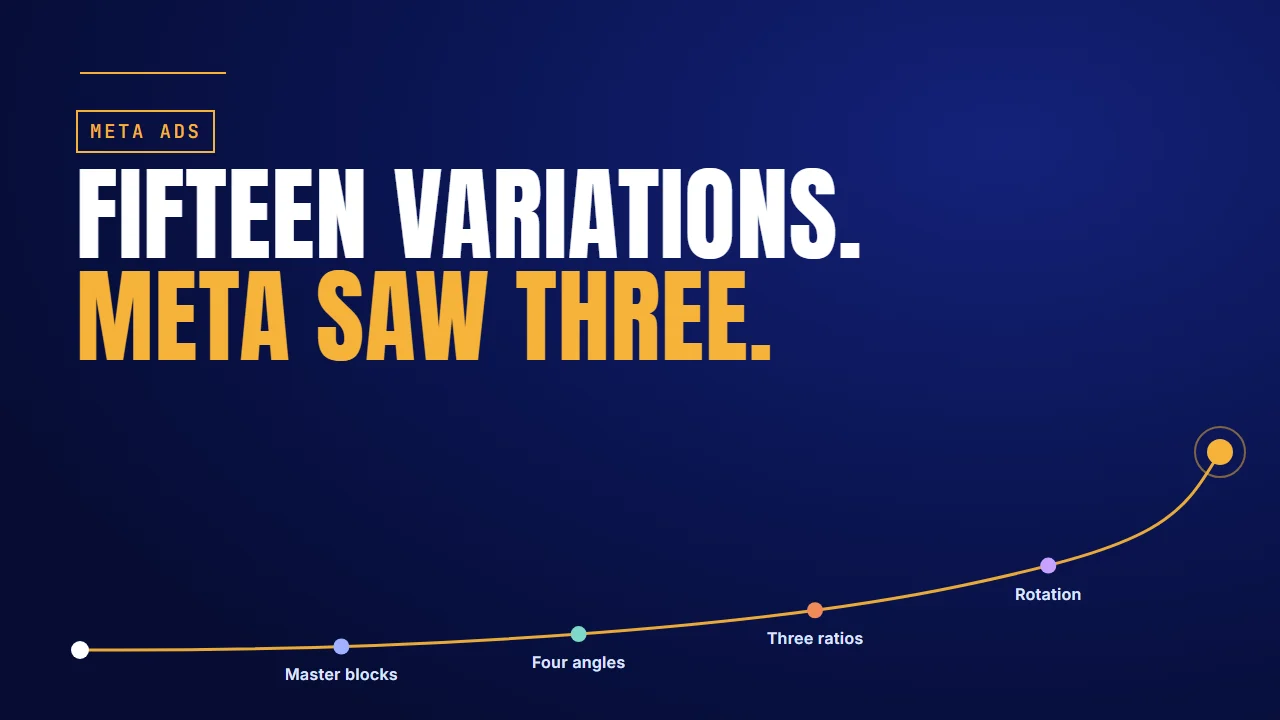
Fifteen variations, Meta saw three: master blocks, four angles, three ratios, rotation

Why it matters

Meta stopped counting hook swaps as new ads

For years the Meta playbook was simple. Record one ad, swap the first line five ways, and test. Alessandro Cutri, who runs Meta ads for B2B software companies, says that no longer works. In his reading, five hooks on three bodies used to give you fifteen ads. Now Meta sees about three.

That is his interpretation, not Meta's wording. But Meta's own guidance points the same way: creative that looks too similar goes to the same people, and the ad wears out.

What counts as a new adWhat the source saysSource
5 hooks on 3 bodiesAbout 3 ads, not 15 (his reading of Meta's system)Alessandro Cutri
Creative that is too similarMay be delivered to the same audiences, then flagged as Creative fatigueMeta, creative differentiation guidance
Genuinely diverse creative, N2665% lower cost per registration, 40% lower cost per ad recallN26, via Meta
How people hold their phones98% hold them verticallyMeta, Instagram video ad best practices

For a SaaS team, that shows up as a cost per lead that creeps up while you keep swapping hooks. Most social media advertising videos are still built that way.

The short answer: build one master animation in blocks that each stand alone. Cut it into four genuinely different angles, then into three aspect ratios. When Ads Manager flags an angle, replace the angle, not the size. Four of the sections below include a video we made for a client.

Your Meta ads wearing out?

Talk to the Advids team about a master animation built to slice into different angles.

Let’s talk

The problem

Too-similar creative goes to the same people

Start with what changed. Meta now uses Andromeda, which Meta Engineering describes as a personalized ads retrieval engine built to handle the growth in creative from Advantage+.

Cutri puts the effect bluntly. Even changing your shirt and re-reading the script doesn't count as a new ad.

Meta's own guidance is close. When creative is too similar, the system may not recognize it as different and may deliver it to the same audiences. That is how an ad ends up with one of two statuses in Ads Manager.

Status in Ads ManagerWhat Meta's guidance points toWhat to change
Creative limitedAds in the set look too alike to be told apartAdd a genuinely different angle
Creative fatigueThe same people keep seeing the same ideaRetire the angle and open a new one

So the fix isn't more ads. It's more different ads. On its creative differentiation page, Meta reports that N26 cut its cost per registration by 65% and its cost per ad recall by 40% with diverse creative. N26 is a mobile bank, not SaaS, and we found no B2B software company with published results like it.

So how do you make genuinely different ads without twelve separate productions?

Master blocks

Build one master animation in blocks

One production, built so every scene can stand on its own.

Think of it like a Lego set. You buy one set with the right pieces and build twelve different things. Marketers call this modular content.

Here is an example structure, not client data. For SaaS, the master runs about 60 seconds, built in blocks:

  • A problem scene.
  • Three or four product scenes, each showing one outcome.
  • A proof scene.
  • An end card.

Animate each block so it stands on its own. Same brand, same style, but no scene depends on the one before it.

This is where animation beats a talking head. To change a talking-head ad, you record it again. To change an animated one, you swap the product scene, the headline or the voice-over line. That is why so many motion graphics ads refresh cheaply.

Fraud.com: one word and one icon per scene

Fraud.com's video gives each part of its fraud defence one word and one icon. Identity sits on a clock face, then a face mesh inside scan brackets. Safeguarding customers sits on a shield. Risk and trust assessment sits on a report page. Every scene stays in the same purple and white. See how we made it.

What works here:

  • No scene needs the one before it to make sense.
  • One palette and one icon style tie the scenes together, so they can be re-ordered without looking stitched.

The move: Give each block one idea, one picture and the same look. Then any block can open a cut.

Now slice the master. The first cut is by angle.

Four angles

Change the reason to care, not the hook

Four angles make four different ads. Five hooks on one body make one.

The angles are what make Meta see your ads as different. Meta's own advice is to show the same product through different reasons to care, such as price, performance or ease of use.

Here is an example structure, not client data. For a reporting tool:

  • Cost: opens on "Your analysts spend Fridays rebuilding reports."
  • Speed: opens on the report building itself in seconds.
  • Ease: opens on a hands-off workflow.
  • Proof: opens on a customer result.

Each angle gets its own opening scene and its own order of blocks. That is a different idea, not a different hook. Even short 15-second animated ads can carry one angle each.

JUMO flowTRANS US: one benefit per scene

JUMO's ad for its flowTRANS US ultrasonic flowmeter gives each benefit its own 3D scene and caption. High process reliability, with the meter wired to a control cabinet. Reduced maintenance costs, with a see-through housing that shows no moving parts. Uncomplicated integration into existing plants, with the meter dropping into a pipe. See how we made it.

What works here:

  • Each caption is a different reason to care: reliability, cost, ease of fitting.
  • Each benefit has a scene of its own, so any one could open a separate ad.

The move: List every reason a buyer might care. Pick four that would each open a different ad, and give each one its own scene.

Four angles give you four ideas. The next cut gets each one into every placement.

Three ratios

Cut every angle for 9:16, 4:5 and 1:1

Ratios get you into every placement. They don't make the ad new.

Meta's Instagram video ad best practices say 98% of people hold their phones vertically, and recommend aspect ratios of 9:16 or 1:1. So cut every angle for 9:16, 4:5 and 1:1. Four angles times three ratios gives twelve ads.

Example angle, not client dataOpens onCuts at 9:16, 4:5 and 1:1
CostAnalysts rebuilding reports every FridayAds 1 to 3
SpeedA report building itselfAds 4 to 6
EaseA hands-off workflowAds 7 to 9
ProofA customer resultAds 10 to 12

Be clear about what ratios do. They get you into Reels, Feed and Stories. They don't make the ad new. Meta's creative diversity metric, as quoted by Soku from Meta's help page, compares the images and video thumbnails in an ad set. A resized version is the same idea. Plan vertical video from the start, as the best mobile video ads do.

Azure AI Search: what holds in a crop, and what doesn't

The Azure AI Search video opens on a centred title, Retrieval-augmented generation. Three search cards follow side by side: keyword, vector and hybrid. A data funnel feeds a list of steps: Ingest, Parse, Enrich, Embed, Index. Then real setup screens and code, and a centred end card. See how we made it.

What works here:

  • Titles, labels and the end card sit in the centre, so a square or vertical crop keeps them.
  • The three cards side by side and the wide setup screens would need their own layout for 9:16.

The move: Plan the crop at the storyboard. Keep claims in the centre, and give wide screens a vertical layout of their own.

That is the build. Even twelve good ads wear out, so the last piece is rotation.

Rotation

Replace the angle when it fatigues

Watch the delivery column, and swap ideas, not sizes.

Watch the delivery column in Ads Manager. When an ad shows Creative limited or Creative fatigue, don't just upload a resized version. Retire that angle and build a new one from your master blocks.

Because the blocks already exist, a new angle is a new opening scene and a re-edit, not a new production.

Keep creative testing simple. Cutri's rule now is one hook per body, two at most. Fraser Cottrell, who has made ads for seven years, adds one more easy variable: a version with B-roll and one without.

Pulumi: two kinds of block, either can lead

Pulumi's video for its developer platform alternates two kinds of block. Animated scenes follow a developer, Sam, from frustration at a laptop to the line Sam ships features in days. Between them, a presenter in a Pulumi T-shirt talks to camera while points appear beside him: Standardization, Centralization, Self-Service, Guardrails. See how we made it.

What works here:

  • The animated story and the presenter are separate blocks, so either can open a cut.
  • The four points on screen are four reasons to care, ready to become four openings.

The move: When an opening wears out, lead with the other kind of block. That is a test of one variable, with the rest of the ad unchanged.

Where to start

Where to start

The short answer: start from what Ads Manager tells you.

If your ad showsStart withDo thisExample to copy
Rising cost per lead, many hook tests on one videoMaster blocksBuild one 60-second master in blocks that stand aloneFraud.com
Creative limitedFour anglesAdd angles with a different reason to care, not new hooksJUMO flowTRANS US
Feed placements onlyThree ratiosCut each angle for 9:16, 4:5 and 1:1Azure AI Search
Creative fatigueRotationRetire the angle, open a new one from your blocksPulumi

Planning the blocks before the script is what makes this cheap. Browse social motion graphics for block ideas, or see the software teams we've made video for.

FAQ

Questions about Meta creative fatigue

What is creative fatigue on Meta?
It is a delivery status in Ads Manager. Meta says creative that is too similar may not be recognized as different, so it may reach the same audiences again.
Do new hooks on the same video count as new ads?
Not really. Alessandro Cutri reads Meta's system as treating five hooks on three bodies as about three ads. Change the reason to care, not just the opening line.
How long should a master animation for Meta ads be?
About 60 seconds works as an example structure: a problem scene, three or four product scenes, a proof scene and an end card, each able to stand alone.
Does resizing a video to 9:16 make it a new ad?
No. Ratios get the ad into Reels, Feed and Stories. Meta's creative diversity check compares images and thumbnails, so a resized cut is the same idea.
How often should a SaaS team replace a Meta ad angle?
Replace it when Ads Manager shows Creative limited or Creative fatigue. Retire the angle and open a new one from your master blocks, rather than uploading another size.
Why is animation cheaper to refresh than a talking-head ad?
A talking-head ad has to be recorded again. An animated one changes by swapping a product scene, a headline or a voice-over line inside blocks that already exist.

About the author

About Jai Ghosh

Video Producer at Advids · LinkedIn

Jai Ghosh is a Video Producer at Advids, where he has planned and produced videos for B2B software and technology companies for 7 years. He works on product demos, explainer videos and brand videos, from the first script to the final cut, for clients from startups to enterprises.

Before Advids, Jai spent over 11 years in freelance media consulting, after starting out in digital journalism. He writes the Advids blog's breakdowns of product and demo videos, sorting real examples by the question each one answers for a buyer.

  • Focus: SaaS product demos, explainer videos and brand videos
  • Experience: 7 years at Advids, over 11 years in media consulting
  • Background: digital journalism

Connect with Jai Ghosh on LinkedIn

Sources

Sources