

Video Marketing

B2B Retargeting Video: How to Turn Warm Traffic into Booked Demos

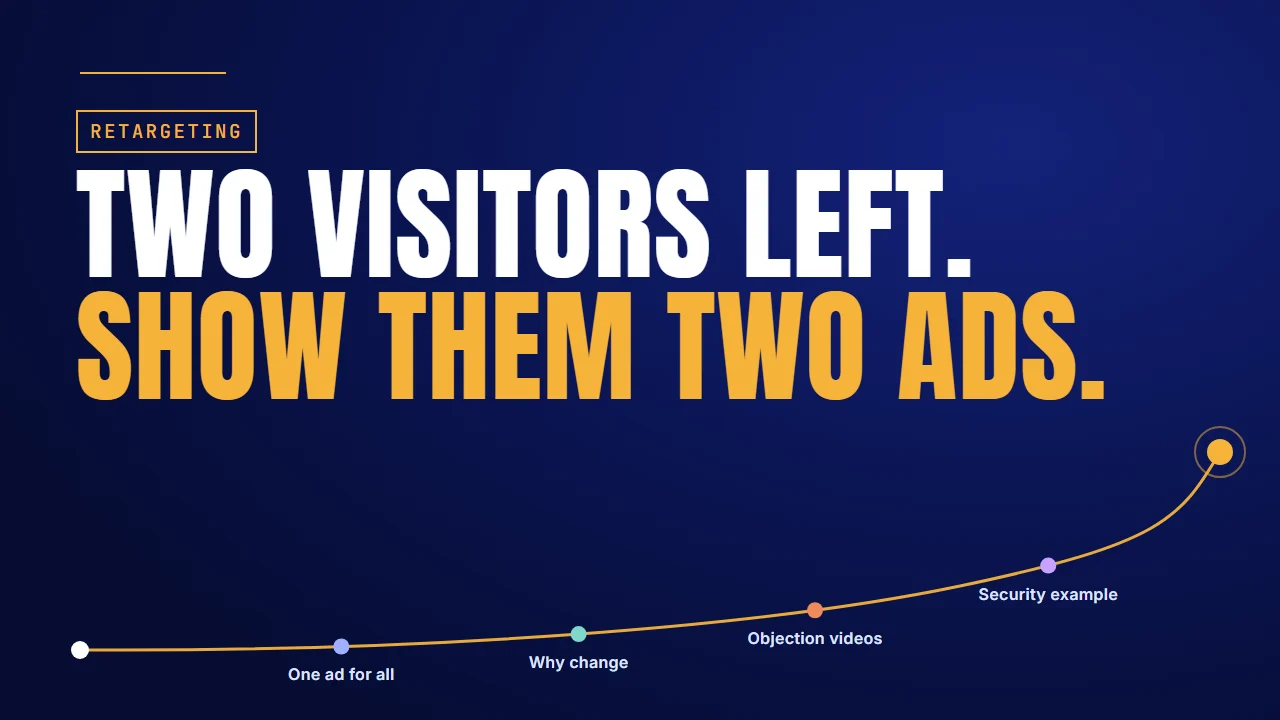
Two visitors left, show them two ads: one ad for all, why change, objection videos, security example

Why it matters

Warm traffic needs more than one retargeting ad

Two people left your website today. One read a blog post. The other spent four minutes on your pricing page.

Tomorrow, most B2B teams show them the exact same retargeting ad. They sit at different points in the buyer's journey, so one ad fits neither, and warm traffic never turns into a booked demo.

AudienceWho they areVideoLengthAsk
WarmRead a blog post, watched a webinar, downloaded a guideWhy change60 to 90 seconds (recommended)A soft offer, such as a product tour
HotLeft the pricing pageOne objection per video30 to 45 seconds (recommended)Book the demo

Two sources back the split. LinkedIn's Matched Audiences best practices suggest testing pricing-page visitors against content-page visitors. And in a LinkedIn customer story, Firebolt moved from pure lead generation to a brand-to-demand approach; the share of leads that became qualified sales meetings rose from 2% to 12% in four months. That was its whole LinkedIn strategy, not video alone. The lengths above are our recommendations, not measured data.

The short answer: split your traffic. Show content readers a short why-change video and retarget whoever watches it. Show pricing-page drop-offs one short video per objection, each ending on one ask: book the demo. Four of the sections below include a video we made for a client.

Planning a retargeting set?

Talk to the Advids team about a why-change video and a short set of objection videos for your product.

Let’s talk

One ad for all

One "Book a demo" ad for every visitor wastes both

The blog reader isn't ready. The pricing visitor doesn't need the intro.

Most teams build one retargeting audience, all website visitors, and hit it with one ad: Book a demo.

The blog reader isn't ready. The pricing visitor already knows what you do.

Ben Heath, who has run Google Ads campaigns for years, warns about a similar trap. If you optimize for clicks, you get what he calls clicky people, who never take the next step.

LinkedIn's own advice is the opposite of one ad for all. Its Matched Audiences best practices say to tailor the ad to what each visitor viewed or did, and to A/B test pricing-page visitors against content-page visitors. Each page view is one of the intent signals you already have.

6sense: buried in ads, then one buyer by what he did

6sense's video opens on a worker at his laptop as ads pour in: SPAM, CLICK ME!, TRY THIS, FREE!. By the middle of the pile only his arm sticks out. Later, one buyer gets a label, IT Manager, with four ticked signals beside him, including Watched demo and Site visits, 3 in 5 days. See how we made it.

What works here:

  • The ad pile shows mass advertising from the receiving end, with no words but the ads.
  • The buyer is defined by what he did, not by a list he was put on.

The move: Before you write a retargeting ad, write down what the viewer did on your site. That action decides which video they see.

So split them, starting with the visitors who came for the content.

Why change

Show warm visitors a "why change" video

Content readers care about the problem. They haven't chosen you yet.

Start with your warm visitors: people who read a blog post, watched a webinar or downloaded a guide. Their video answers one question. Why change at all?

Alessandro Cutri, who runs paid acquisition for B2B software companies, compares it to buying a house. At the open-house stage, you don't want the mortgage paperwork. You want to picture yourself living there.

Here is an example structure, not client data:

  • Open on the costly problem they were reading about.
  • Show the mechanism, how your product fixes it, in two or three animated scenes.
  • End on a soft offer, not a sales call.

Keep it to 60 to 90 seconds. The soft offer can be a short product tour or an interactive product tour.

RingCX: the product at work, then a soft close

RingCX's video for its AI-first contact center moves in short type: fast, easy to set up. Then the product works on screen: an agent's message thread, then a call card scoring Sentiment as Positive and Energy at 96.9. It closes on lines, not a form: Priced just right, Get started fast, Smarter customer service made simple. See how we made it.

What works here:

  • The mechanism is shown on real-looking screens, not described.
  • It never asks for a demo. It ends on a promise a warm viewer can act on later.

The move: Keep the soft close. For a why-change cut, put one costly problem in front of the product scenes, since this video opens on the product.

Here is a bonus. Anyone who watches most of that video becomes your next, warmer audience. LinkedIn lets you retarget people who watched your video ads, and Meta lets you build custom audiences from people who engaged with your videos.

Now the hot group: the visitors who saw your price and left.

Objection videos

Answer the objection that stopped pricing visitors

Pricing-page drop-offs know what you do. Something stopped them.

This video doesn't explain the product again. It answers the objection. Among common sales objections, three come up most for software:

  • How long will implementation take?
  • Is it secure?
  • Will it pay for itself?

Make one short video per objection, 30 to 45 seconds each. Name the worry out loud, then answer it with something concrete: a timeline graphic, a security badge or a customer's number. End with one clear ask: book the demo.

Aleric Heck, who runs a YouTube ads agency, retargets people who watched his videos and says the booked calls come in every month like clockwork. That is his own claim about his own business. Good sales demo videos often open the same way, on the doubt.

Quantiphi Q2Q: two doubts, then three steps

Quantiphi's ad for Quick to QuickSight opens on a woman at her laptop, hand on chin, under a title about the rising cost of BI tools. Then the doubts, as titles: Want to migrate to Amazon QuickSight? Not sure about the cost & time? A dollar icon and a clock sit below. The answer comes as three titled steps: Inventory, Analyze, Migrate. See how we made it.

What works here:

  • The objection is said out loud, in the buyer's words, before any product.
  • The answer is concrete: three named steps the buyer can picture.

The move: Copy the structure, not the length. At almost a minute and a half, this ad runs longer than an objection video should, so cut it to one doubt and one answer.

Here is how one of those objection videos could run, start to finish.

Security example

Answer security with proof the buyer can check

One worked objection video, about 40 seconds long.

Here is an example script, not client data. Say the objection is security.

  • The worry: "Nervous about handing us your customer data?"
  • Beat one: your compliance badges.
  • Beat two: where the data actually lives.
  • Beat three: a customer in their industry who passed the same review.
  • The ask: "Book a demo with our security team."

That is about 40 seconds, and it speaks to exactly one fear. The third beat can come from your customer story videos.

Visa Direct: every figure with its qualifier

Visa's explainer for Visa Direct, made for a risk and compliance audience, draws money moving from an office block to a small shop past a shield with a check mark. A footnote sits on the same screen: actual fund availability varies by receiving financial institution. A world map follows with Reach billions of endpoints. See how we made it.

What works here:

  • The qualifier sits beside the claim, so a reviewer doesn't have to ask for it.
  • The proof is drawn simply: a shield, a route, a map.

The move: For a security video, show the evidence a reviewer will check, and put its fine print on the same screen.

Two videos, two audiences. But does warming people first lead to more demos?

Warm then demand

Warm first, then ask for the demo

Fewer leads can mean better meetings.

Firebolt, a cloud data warehouse company, measured it. In its LinkedIn customer story, it moved from pure lead generation to a brand-to-demand approach. Lead volume went down. But the share of leads that became qualified sales meetings rose sixfold.

2% to 12%

Firebolt's MQL-to-SQL conversion, four months after moving from pure lead generation to brand-to-demand on LinkedIn. Source: Firebolt, LinkedIn customer story. Full-funnel LinkedIn, not video alone.

Its head of demand generation, Itay Waisman, called the shift scary. In the story, he says that without brand awareness and product knowledge first, demand generation was expensive and ineffective. That is the gap between demand generation and lead generation.

The result covers Firebolt's whole LinkedIn programme, not retargeting video alone. It still shows the shape of the funnel: educate the warm group, answer the hot group, and the demos get better. The same split works for other B2B ad styles.

Where to start

Where to start

The short answer: start from the page they left on.

If they last visitedStart withDo thisExample to copy
Any page, one ad for allOne ad for allSplit the audience by what they viewed6sense
A blog post, webinar or guideWhy change60 to 90 seconds: problem, mechanism, soft offerRingCX
The pricing pageObjection videosOne objection per video, 30 to 45 seconds, book the demoQuantiphi Q2Q
Security or trust pagesSecurity exampleBadges, where data lives, a peer customerVisa Direct
Your video ad, most of the way throughWarm then demandRetarget viewers with the objection videoFirebolt's story

The demo itself still matters once they book; B2B demo videos can carry that meeting forward. See the software teams we've made video for.

FAQ

Questions about B2B retargeting video

Should all website visitors see the same retargeting video?
No. LinkedIn's best practices suggest tailoring ads to what visitors viewed and testing pricing-page visitors against content-page visitors. Readers and pricing drop-offs need different videos.
How long should a retargeting video for pricing-page visitors be?
We recommend 30 to 45 seconds, covering one objection. Name the worry, answer it with something concrete, then make one ask: book the demo.
What objections should a B2B retargeting video answer?
Usually one of three: how long implementation takes, whether it is secure, and whether it pays for itself. Make one short video for each objection.
Can I retarget people who watched my video ad?
Yes. LinkedIn lets you retarget people who watched your video ads, and Meta lets you build custom audiences from people who engaged with your videos.
Does warming buyers up first reduce lead volume?
It can. In LinkedIn's customer story, Firebolt's lead volume fell after a brand-to-demand shift, while its MQL-to-SQL conversion rose from 2% to 12% in four months.
What should the call to action be for warm visitors?
A soft offer, such as a short product tour, not a sales call. Save book the demo for pricing-page visitors, who have already seen your price.

About the author

About Jai Ghosh

Video Producer at Advids · LinkedIn

Jai Ghosh is a Video Producer at Advids, where he has planned and produced videos for B2B software and technology companies for 7 years. He works on product demos, explainer videos and brand videos, from the first script to the final cut, for clients from startups to enterprises.

Before Advids, Jai spent over 11 years in freelance media consulting, after starting out in digital journalism. He writes the Advids blog's breakdowns of product and demo videos, sorting real examples by the question each one answers for a buyer.

  • Focus: SaaS product demos, explainer videos and brand videos
  • Experience: 7 years at Advids, over 11 years in media consulting
  • Background: digital journalism

Connect with Jai Ghosh on LinkedIn

Sources

Sources